
Table of Contents
- The State of Wild Hedgehog Conservation
- Core Conservation Terminology
- The National Hedgehog Conservation Strategy
- Creating Hedgehog Highways: Habitat Connectivity
- Designing the Ideal Wild Habitat
- Supplemental Feeding and Nutrition
- Identifying and Helping Dehydrated or Sick Hedgehogs
- Managing Predators and Garden Hazards
- Do Hedgehogs Recognize Humans?
- Seasonal Care Calendar
- Key Takeaways for Garden Conservation
- Related Resources and Further Reading
The State of Wild Hedgehog Conservation
Britain’s hedgehogs are disappearing fast — and the suburban garden may be their best remaining lifeline.
Rural hedgehog populations have collapsed by between 30% and 75% since 2000, according to the State of Britain’s Hedgehogs 2022 Report. Intensive farming, habitat fragmentation, and pesticide use have stripped the countryside of the food sources and shelter these animals depend on.
The State of Wild Hedgehog Conservation
Britain’s hedgehogs are disappearing fast — and the suburban garden may be their best remaining lifeline.
Rural hedgehog populations have collapsed by between 30% and 75% since 2000, according to the State of Britain’s Hedgehogs 2022 Report. Intensive farming, habitat fragmentation, and pesticide use have stripped the countryside of the food sources and shelter these animals depend on.
Yet while rural numbers freefall, urban wildlife conservation and suburban environments tell a more complicated — and more hopeful — story. Gardens now function as the primary refuge for wild hedgehogs across much of Britain.
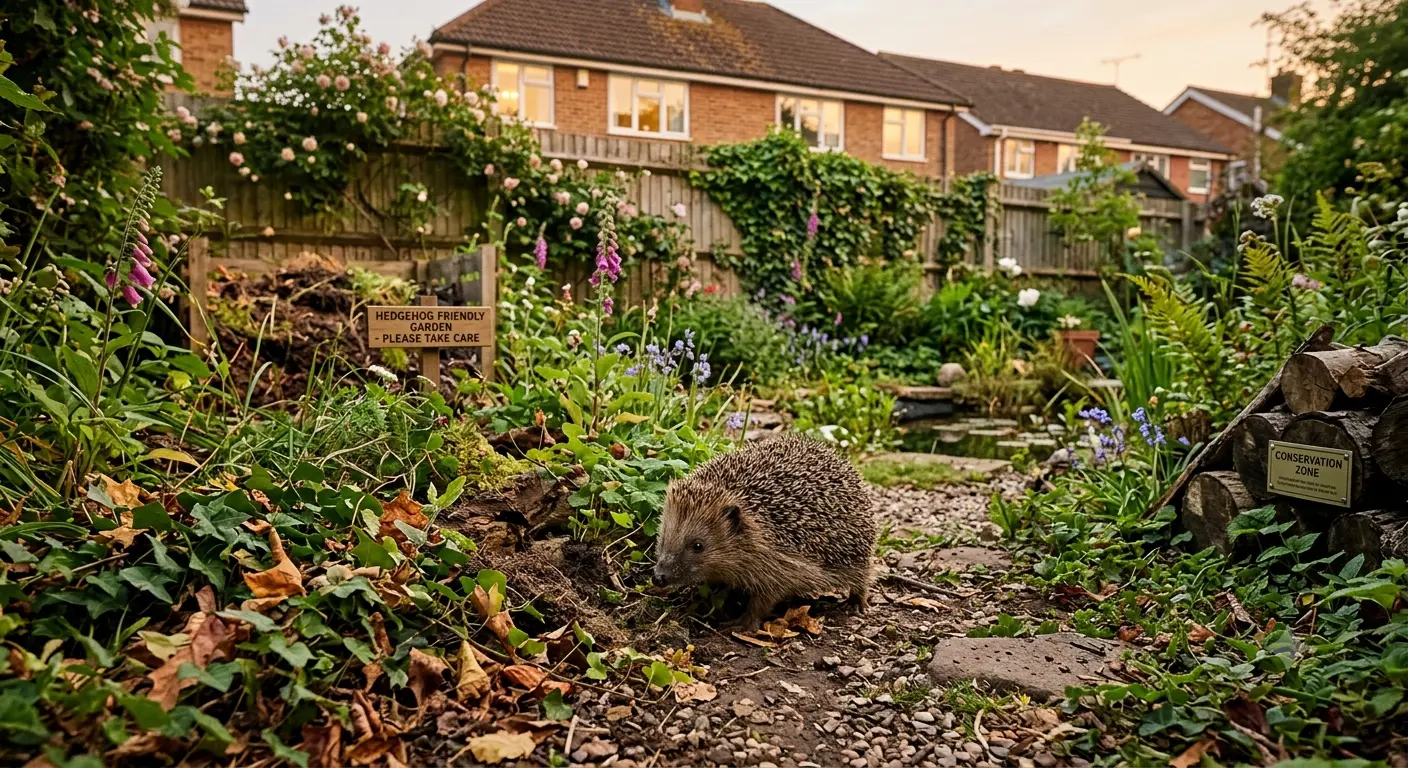
The challenge is that most gardens operate as isolated islands. Solid boundary fencing cuts off movement between plots, turning what could be a connected wildlife corridor into a patchwork of dead ends.
A hedgehog can roam up to two miles in a single night foraging for food, so a single well-managed garden, no matter how thoughtfully maintained, cannot sustain a population alone. The real conservation opportunity lies in linking those islands together — and that starts with understanding how to make your garden hedgehog friendly in ways that extend beyond your own boundary.
This is where pet and reptile hedgehog owners hold a distinct advantage. Anyone who has cared for an African pygmy hedgehog indoors already understands hedgehog behavior, dietary needs, and the importance of appropriate shelter and space — knowledge that translates directly into smarter garden design decisions.
That familiarity with hedgehog biology removes the guesswork and accelerates meaningful action. The sections that follow build on this foundation — starting with the essential vocabulary that conservation organizations and wildlife gardeners use to coordinate connected habitat efforts.
Core Conservation Terminology
Understanding the language of hedgehog conservation is the first step toward taking meaningful action in your own backyard.
Before diving into specific strategies, it helps to get familiar with the key terms conservationists use — because these concepts shape every practical recommendation you’ll encounter.
Hedgehog Highway
A connected network of small openings cut through garden fences and walls, allowing hedgehogs to roam freely between neighboring properties in search of food, mates, and safe nesting sites.
Hibernaculum
A sheltered, insulated winter nesting site — either purpose-built or naturally occurring — where a hedgehog enters torpor and survives the cold months on stored fat reserves.
Hoglet
A juvenile hedgehog, typically born between May and September, that depends on its mother for the first four to six weeks before venturing out independently.
Permeability
A measure of how easily wildlife, including hedgehogs, can move through a landscape — determined largely by the presence or absence of gaps in fences, walls, and other garden boundaries.
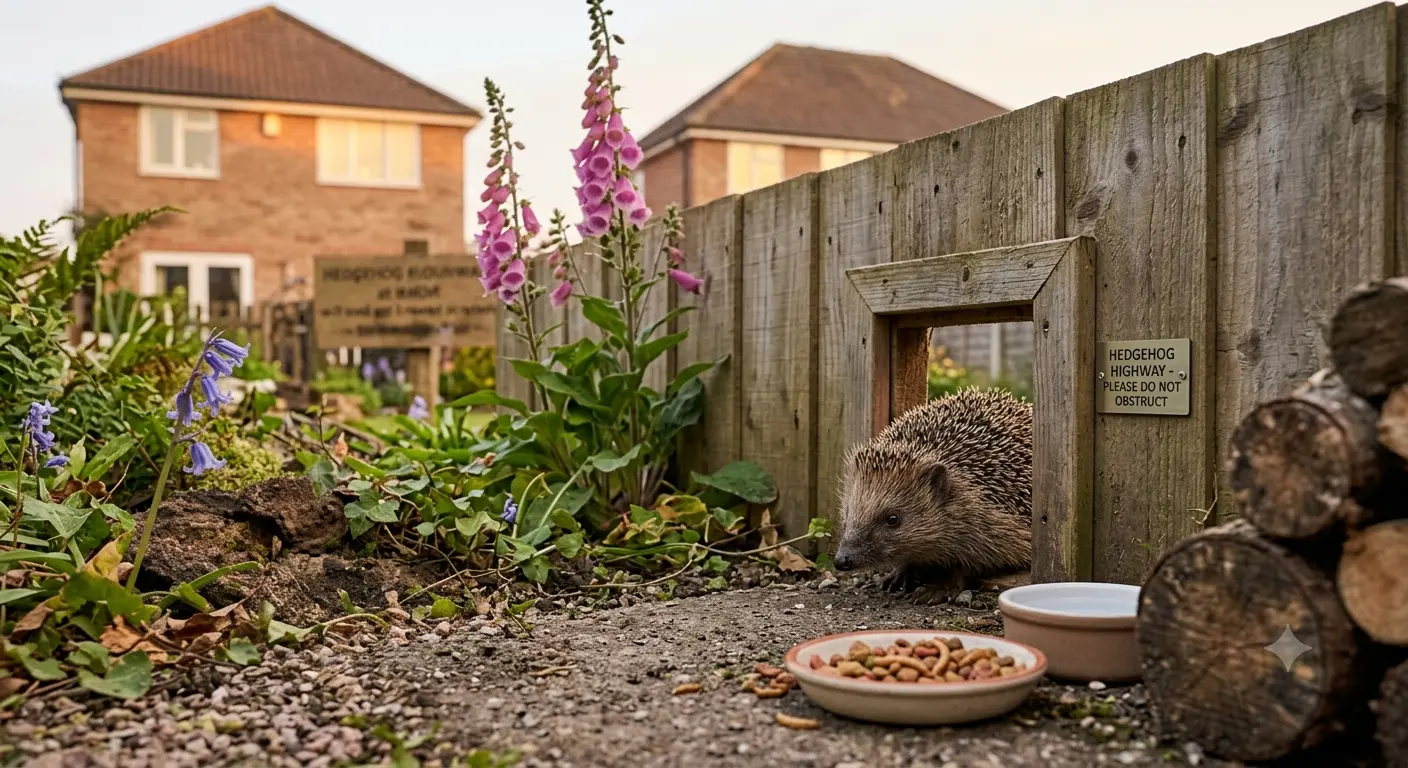
Permeability is arguably the single most critical factor in urban hedgehog survival. According to Hedgehog Street, a gap of just 13cm x 13cm at the base of a garden fence is all it takes to create a functional Hedgehog Highway — a remarkably small modification with an outsized conservation impact.
These terms aren’t just jargon. A hoglet, for instance, separated from its mother and found out during daylight hours is likely in distress — just as knowing how to help a dehydrated hedgehog (offering water, never milk) can be lifesaving in that moment.
Understanding what a hibernaculum does also explains why leaving parts of your garden “messy” is actively beneficial. For anyone interested in caring for hedgehogs more broadly, these foundational concepts make every subsequent step more intuitive.
This vocabulary underpins the coordinated, nationwide approach that wildlife charities have built — which is exactly where we turn next.
The National Hedgehog Conservation Strategy
Britain’s first coordinated national response to hedgehog decline represents a landmark shift from isolated goodwill to organized, landscape-scale action.
For decades, hedgehog conservation was largely reactive — individual rescuers, scattered wildlife groups, and well-meaning gardeners operating without a shared framework.
That changed when leading wildlife charities, including the People’s Trust for Endangered Species (PTES) and the British Hedgehog Preservation Society (BHPS), collaborated to produce the UK’s first ever National Hedgehog Conservation Strategy.
Launched as a ten-year roadmap, the strategy formalized conservation goals across research, public engagement, and habitat improvement.
“Gardens represent an important and underutilized resource for hedgehog conservation, and connecting them at a landscape scale is central to the strategy’s aims.” — Conservation Strategy for the Hedgehog in the UK, 2015–2025
The strategy’s central goal is garden connectivity — creating a linked network of green spaces that hedgehogs can move through freely.
Research published in PLOS ONE assessed how well this connectivity model translates into measurable population benefits, confirming that fragmented gardens act as bottlenecks that limit foraging range and breeding success.
Crucially, the strategy doesn’t place the burden solely on conservation professionals. Individual homeowners are positioned as frontline contributors, each responsible for a small but meaningful piece of a much larger habitat mosaic.
Practical steps — removing boundary barriers, reducing pesticide use, and providing supplemental food like wet cat or dog food (a common question is whether do hedgehogs eat cat or dog food — they do, in moderation) — all align directly with the strategy’s recommendations.
What makes this framework powerful is its scalability. A single hedgehog hole in one fence is a gesture; twenty connected gardens on the same street become a wildlife corridor. That principle of street-level connectivity is exactly what the next section explores in detail.
Creating Hedgehog Highways: Habitat Connectivity
A single hedgehog highway connecting just a handful of gardens can transform isolated green patches into a functioning wildlife corridor — and it’s one of the most impactful acts of wild hedgehog conservation available to any homeowner.
Hedgehogs are natural wanderers. A single animal typically travels between 1 and 2 kilometers every night in search of food, mates, and nesting sites.
When solid fences and walls fragment that range, hedgehogs become trapped in isolated pockets — unable to find sufficient resources or breed with individuals beyond their immediate area.

According to Hedgehog Street, Hedgehog Highways directly prevent genetic isolation by allowing animals to roam freely across connected territories. Without that connectivity, even the most wildlife-friendly garden functions as a gilded cage.
A 13cm × 13cm gap at the base of a fence or wall is all a hedgehog needs to move freely between gardens. Creating that gap safely follows a straightforward process:
- Locate the base of your fence panel or wall at ground level, ideally in a corner to minimize structural disruption.
- Mark a 13cm × 13cm square using chalk or masking tape before cutting.
- Use a jigsaw for timber panels or a cold chisel and hammer for brick walls — always wear eye protection and gloves.
- Smooth any rough edges to prevent injury to the animal’s soft underside.
- Mark the gap with a small “Hedgehog Highway” sign so the hole isn’t accidentally blocked by future garden work.
Collaborating with neighbors multiplies the impact dramatically. One gap helps; a connected street of gaps creates a genuine wildlife corridor.
In practice, a simple conversation — or a note through the door — is often enough to recruit the households around you. Many local conservation groups supply free gap-cutting templates and signage to encourage exactly this kind of street-level coordination.
With connectivity established, the next logical step is ensuring the gardens within that network actually provide the food, shelter, and nesting resources hedgehogs need to thrive — which is where thoughtful habitat design comes in.
Designing the Ideal Wild Habitat
The single most effective step any garden owner can take for hedgehogs is resisting the urge to tidy everything away.
As Fay Vass of the British Hedgehog Preservation Society puts it, “The most important thing people can do is to provide a variety of habitats in their gardens, such as log piles and areas of long grass.”
That advice cuts against the grain of pristine, manicured outdoor spaces — but nature rarely thrives in neat corners.
Over-tidying strips away the structural complexity hedgehogs depend on for shelter, foraging, and safe passage. Leaf litter, fallen branches, and unmown grass margins aren’t neglect — they’re architecture.
Nesting Features
- Log piles placed against a fence or wall create insulated cavities hedgehogs readily adopt as daytime resting spots or winter hibernacula.
- Compost heaps generate warmth through decomposition, making them attractive nesting sites — though care is needed before turning them with a fork.
- Leaf piles tucked into quiet corners replicate the natural woodland floor debris hedgehogs build nests from in the wild.
- A purpose-built or store-bought hedgehog house sited in a sheltered, shaded spot away from prevailing wind provides a reliable alternative when natural debris is limited.
Foraging Zones
- Long grass margins along fences and borders shelter beetles, earthworms, and slugs — the core of a wild hedgehog’s diet.
- Leaving fallen fruit and organic mulch undisturbed creates invertebrate-rich microhabitats.
- Avoid pesticide use; research from PTES links chemical garden treatments to prey scarcity.
Safety Considerations
- Check for hedgehogs before using strimmers, mowers, or garden forks in dense vegetation.
- Cover or slope-fit ponds and drains — steep-sided water features are a documented drowning hazard.
- Ensure hedgehog highways remain clear of obstructions so animals can move freely between connected gardens at night.
Supplemental Feeding and Nutrition
What you put in a feeding station can directly determine whether a hedgehog survives its first winter — making food choice one of the highest-impact decisions a garden supporter can make.
Meat-based wet cat or dog food is the gold standard for supplemental hedgehog feeding. It closely mirrors a hedgehog’s natural diet of invertebrates, delivers the protein and fat content they need to build body reserves, and is widely available at low cost.
Dry cat biscuits are also a solid choice, supporting dental health alongside caloric intake. The British Hedgehog Preservation Society consistently recommends these options as safe, species-appropriate staples.
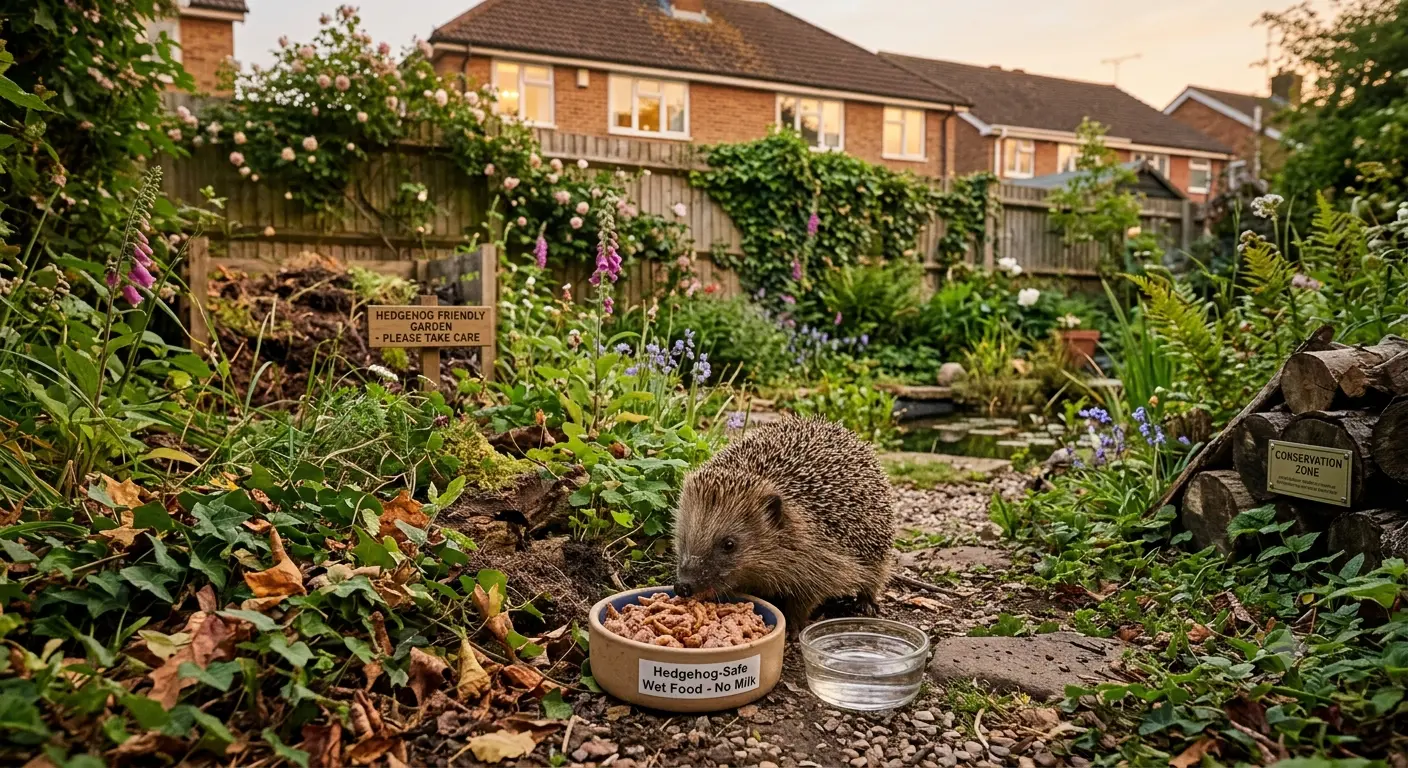
Reaching the right hibernation weight is genuinely life or death for younger animals. According to the RSPCA, supplemental feeding can increase overwinter survival rates for hoglets by helping them reach the critical 450g–600g threshold before they enter torpor.
Hedgehogs that fall below this weight often don’t survive the cold months. Autumn feeding — particularly from September through November — is therefore the highest-value window for garden supporters to maintain a reliable food supply.
Equally important is knowing what not to offer. Several common food myths persist despite clear guidance from wildlife organizations:
| Food Type | Recommended | Reason |
|---|---|---|
| Wet cat/dog food | ✅ Yes | High protein, mirrors natural diet |
| Dry cat biscuits | ✅ Yes | Calorie-dense, good for teeth |
| Mealworms | ⚠️ Sparingly | Can cause metabolic bone disease in excess |
| Bread | ❌ No | Low nutrition, causes digestive upset |
| Cow’s milk | ❌ No | Hedgehogs are lactose intolerant |
| Fruit/seeds | ❌ No | Not part of natural diet; attracts rats |
Even well-intentioned feeding can cause harm if a hedgehog is already unwell. The next section covers how to recognize signs of illness or dehydration in visiting hedgehogs — and what to do when you spot them.
Identifying and Helping Dehydrated or Sick Hedgehogs
Knowing when a hedgehog needs human help — and acting within the first hour — can be the difference between survival and death.
The guidance underpinning the National Hedgehog Conservation Strategy consistently emphasizes that public awareness of distress signs is one of the most underleveraged tools in hedgehog recovery.
Daytime activity is the clearest red flag. According to the British Hedgehog Preservation Society, seeing a hedgehog out during the day is often a direct sign of distress, dehydration, or illness. Healthy hedgehogs are strictly nocturnal.
A hog stumbling in daylight, lying flat and motionless (“sunbathing”), or moving in unsteady circles is not relaxing — it is likely in crisis. Watch for these warning signs:
- Lying still in the open during daylight hours
- Wobbly, uncoordinated movement or circling
- Labored breathing or audible wheezing
- Visible flies, maggots, or wounds on the body
- Significant weight loss — ribs or spine visible through spines
Immediate Action: Do not offer milk. Place the hedgehog gently in a high-sided cardboard box lined with a towel, with a shallow dish of fresh water. Keep it in a warm, quiet indoor space and handle it as little as possible.
A warm, dark environment reduces stress while you arrange professional help. In practice, a covered hot water bottle wrapped in a cloth — not direct heat — provides a safe temperature buffer for a hypothermic animal.
Contact a specialist without delay. The BHPS helpline connects callers to trained local rehabilitators. Do not attempt to treat injuries yourself.
Your role is stabilization and rapid handoff — the outcome improves significantly the faster a sick hedgehog reaches professional care.
Even a garden that provides excellent habitat and nutrition is not immune to injured visitors. The next section examines how to reduce two other major threats: active predators and the everyday garden hazards that injure hundreds of hedgehogs each year.
Managing Predators and Garden Hazards
A garden that looks spotless to humans can be a lethal obstacle course for hedgehogs — and the threats don’t always come from wildlife. From foxes to strimmer blades to tangled netting, understanding these hazards is essential to any serious hedgehog conservation effort.
Common garden hazards to eliminate first:
- Garden netting and fruit cages — hedgehogs become fatally entangled overnight; always peg netting at least 12 inches off the ground or remove it after dark
- Uncovered drains and deep trenches — hedgehogs cannot climb sheer walls; a single uncovered drain can trap and kill
- Ponds without exit ramps — hedgehogs are capable swimmers but drown when they can’t exit; add a sloped plank or mesh ramp
- Pesticides and slug pellets — eliminate the insect prey hedgehogs depend on, and toxic pellets kill directly
- Bonfires and compost heaps — always check before lighting or turning; hedgehogs nest inside both
As Surrey Wildlife Trust notes, tidiness itself is a threat — litter and netting are lethal traps for foraging hedgehogs. Ironically, the manicured garden poses more danger than a wild one.
Fox-Proofing Without Hedgehog Exclusion
Foxes are opportunistic predators, but healthy adult hedgehogs rarely fall victim — their spines are an effective defense. Juveniles and sick individuals are more vulnerable.
Rather than exclusion fencing, which would also block hedgehog movement, a practical approach is removing attractants: secure compost bins, don’t leave pet food outdoors overnight, and eliminate dense low-cover where foxes ambush.
Before using any powered garden tool, conduct a slow visual sweep of long grass, leaf piles, and borders. Strimmer injuries are among the most common causes of hedgehog casualties presented to wildlife rescues, and they are entirely preventable.
Mow on the highest blade setting first, then check again before lowering. As you build a safer physical environment, you may start noticing repeat visitors — which raises a fascinating question about just how much a hedgehog actually perceives about the humans sharing its territory.
Do Hedgehogs Recognize Humans?
Hedgehogs don’t see humans — they smell them, and that distinction shapes everything about how a meaningful, ethical connection between species can develop.
Sensory perception is the starting point. Hedgehogs have poor eyesight but an extraordinarily acute sense of smell.

According to WildCRU research, hedgehogs primarily navigate by scent and can become accustomed to the presence of a regular feeder. In practice, this means a hedgehog that visits your garden nightly isn’t “tame” — it has simply mapped your scent onto a safe, food-rich location. That’s a meaningful distinction.
Habituation vs. taming is where many well-intentioned gardeners cross an important line. Habituation describes a wild animal learning that a specific stimulus — your scent, your feeding routine, the sound of a door — poses no threat.
Taming implies behavioral dependency on humans, which compromises a hedgehog’s survival instincts. A habituated hedgehog will pause, sniff the air, and carry on foraging.
A tamed one may approach humans unprompted, a behavioral shift that signals stress or unhealthy reliance rather than affection. The goal is always to remain a predictable, non-threatening presence — not a companion.
The ethics of interaction follow naturally from this. Handling wild hedgehogs should be limited to welfare emergencies — situations covered earlier in this guide, such as injury or daytime distress.
Casual handling removes the animal’s natural wariness, which is a critical survival tool against predators. One practical approach is to observe from a distance, feed consistently, and resist the urge to intervene unless genuine need arises.
If you’re curious about how animal perception works across species, the underlying sensory biology is often more nuanced than expected. Respect, not relationship, is the gold standard for wild hedgehog interaction — and the animals thrive best when that boundary holds firm.
With those principles in place, understanding how your support responsibilities shift across the calendar year becomes the natural next step.
Seasonal Care Calendar
Effective hedgehog support isn’t a one-time setup — it’s a year-round rhythm that shifts with each season, matching what hedgehogs need as their biology changes.
Spring (March–May): High-protein recovery
Hedgehogs emerging from hibernation are depleted and vulnerable. According to the British Hedgehog Preservation Society, hedgehogs typically hibernate from November through March, meaning early spring visitors have gone months burning fat reserves.
Offer meaty wet cat food or specialist hedgehog food immediately — this high-protein boost accelerates recovery faster than grain-heavy alternatives. Avoid milk and bread entirely; both cause digestive distress.
March is also the right time to inspect any hedgehog houses installed the previous autumn and clear out old nesting material before new occupants arrive.
Summer (June–August): Water as a priority
In practice, summer heatwaves create a hidden crisis in hedgehog-friendly gardens. Natural water sources dry up, insects become scarce in parched soil, and hedgehogs — which can travel up to two miles nightly — expend enormous energy for diminishing returns.
A shallow dish of fresh water, changed daily, can be genuinely life-saving during dry spells. Position it in a shaded spot to slow evaporation.
Summer is also peak activity season, so this is the ideal time to confirm your garden connectivity — gaps and Hedgehog Highways — are clear of summer growth that might have blocked access points.
Autumn (September–October): Hibernation preparation
Hedgehogs spend autumn aggressively building fat reserves. Supplemental feeding through October supports this process directly.
Clean out hedgehog houses by late September, replacing damp or parasitic nesting material with fresh dry leaves.
A clean, dry nest box significantly improves hibernation survival odds — moisture inside a hibernaculum accelerates heat loss and attracts harmful fungal growth.
Key Takeaways for Garden Conservation
Four simple actions — a gap in your fence, a bowl of water, a wild corner, and a machinery check — can meaningfully shift the odds for hedgehogs in your neighborhood.
Conservation at scale begins with individual gardens. As the RHS notes, small changes across multiple plots create the large-scale connected habitat hedgehogs need to survive and reproduce.
No single garden can do it alone, but every garden that commits to the basics adds a vital link in the chain. Here are the four highest-impact actions to take right now:
- Install a 13cm x 13cm Hedgehog Highway: Cut or drill a hole at the base of your fence or wall — exactly 13cm square. This standardized size lets hedgehogs through while excluding larger animals.
- Provide supplemental food and fresh water: Meat-based cat or dog food (not fish-flavored) placed in a shallow dish supports hedgehogs through food-scarce nights. Always pair it with fresh water.
- Leave a wild corner untouched: A log pile, a patch of long grass, or a leaf heap costs nothing but delivers critical nesting and foraging habitat.
- Check before using garden machinery: Before strimming, mowing, or raking bonfires, probe the area with a stick. Machinery injuries are entirely preventable.
One garden is a shelter. A whole street acting together is a habitat. If you’re ready to go deeper — whether that’s building your own hedgehog house or assembling a first aid kit for injured visitors — the resources in the next section will point you in the right direction.
Related Resources and Further Reading
Every practical step in this guide becomes more effective when backed by trusted organizations and deeper DIY knowledge — the resources below are your next move.
Wild hedgehog conservation is a collaborative effort. Reporting your sightings to national databases helps scientists track population trends across the UK, turning individual garden observations into meaningful data.
Spoke guides on this site:
- Building a DIY Hedgehog House — A step-by-step walkthrough covering materials, placement, and weatherproofing to give hedgehogs a safe hibernation and nesting site.
- Hedgehog First Aid Kit — What to keep on hand, how to recognize a hedgehog in distress, and when to call a wildlife rehabilitator instead of intervening yourself.
External authorities and reporting tools:
- British Hedgehog Preservation Society (BHPS) — The UK’s leading hedgehog welfare organization; use their site to find local rehabilitators.
- Hedgehog Street — A joint BHPS and PTES campaign where you can log sightings and map hedgehog activity in your neighborhood.
- PTES Hedgehog Conservation Strategy — The foundational policy document outlining science-based priorities for protecting hedgehogs.
- RHS National Hedgehog Conservation Strategy — Practical guidance from the Royal Horticultural Society on aligning garden design with hedgehog recovery goals.
Start with one resource, take one action, and build from there. The hedgehog population’s recovery depends on exactly the kind of informed, consistent effort this guide makes possible.