
Understanding strict hedgehog temperature requirements is critical because your exotic pet’s enclosure isn’t décor — it’s a precision life-support system, and getting the physics wrong can be fatal.
An enclosure that fails thermally isn’t just uncomfortable; it’s biologically catastrophic for animals with no physiological fallback.
Most pet owners think about temperature the way they think about a thermostat — set it and forget it. But for ectotherms like reptiles, and even small mammals like hedgehogs, “ambient temperature” is a dangerously oversimplified metric.
A single temperature reading tells you almost nothing about what an animal actually experiences. Heat moves through air, substrate, hides, and water at different rates, creating invisible microclimates within centimeters of each other.
What registers as 78°F at cage height might be 65°F at substrate level — a gap that can mean the difference between a thriving animal and a critically stressed one.
This is where thermal regulation and environmental engineering become essential frameworks for every keeper to understand, not just researchers.
As the Journal of Exotic Pet Medicine notes, “providing a thermal gradient is essential, allowing the animal to choose its preferred temperature at any given time, which varies based on digestion, pregnancy, or immune response.”
In other words, your job isn’t to set one temperature — it’s to engineer a range of thermal zones your animal can navigate by instinct.
Getting this right starts with understanding how heat actually behaves in an enclosed space. For hedgehog owners especially, the basics of responsible housing are just the beginning.
The real challenge — and the real risk — lies in the narrow thermal window these animals require, and what happens when that window closes.
The Hedgehog’s Narrow Window: Critical Hedgehog Temperature Requirements
African Pygmy Hedgehogs live or die within a temperature band most owners don’t realize is this tight — and getting it wrong triggers a biological crisis that looks like sleep but often ends in death.
The critical number to memorize: your hedgehog’s thermal environment must stay between 72°F and 80°F at all times, according to the Hedgehog Welfare Society. Drop below that window, even briefly, and the animal begins shutting down.
Understanding the biology is crucial. African Pygmy Hedgehogs are not European hedgehogs. Wild European species evolved genuine, fat-fueled hibernation as a survival strategy.
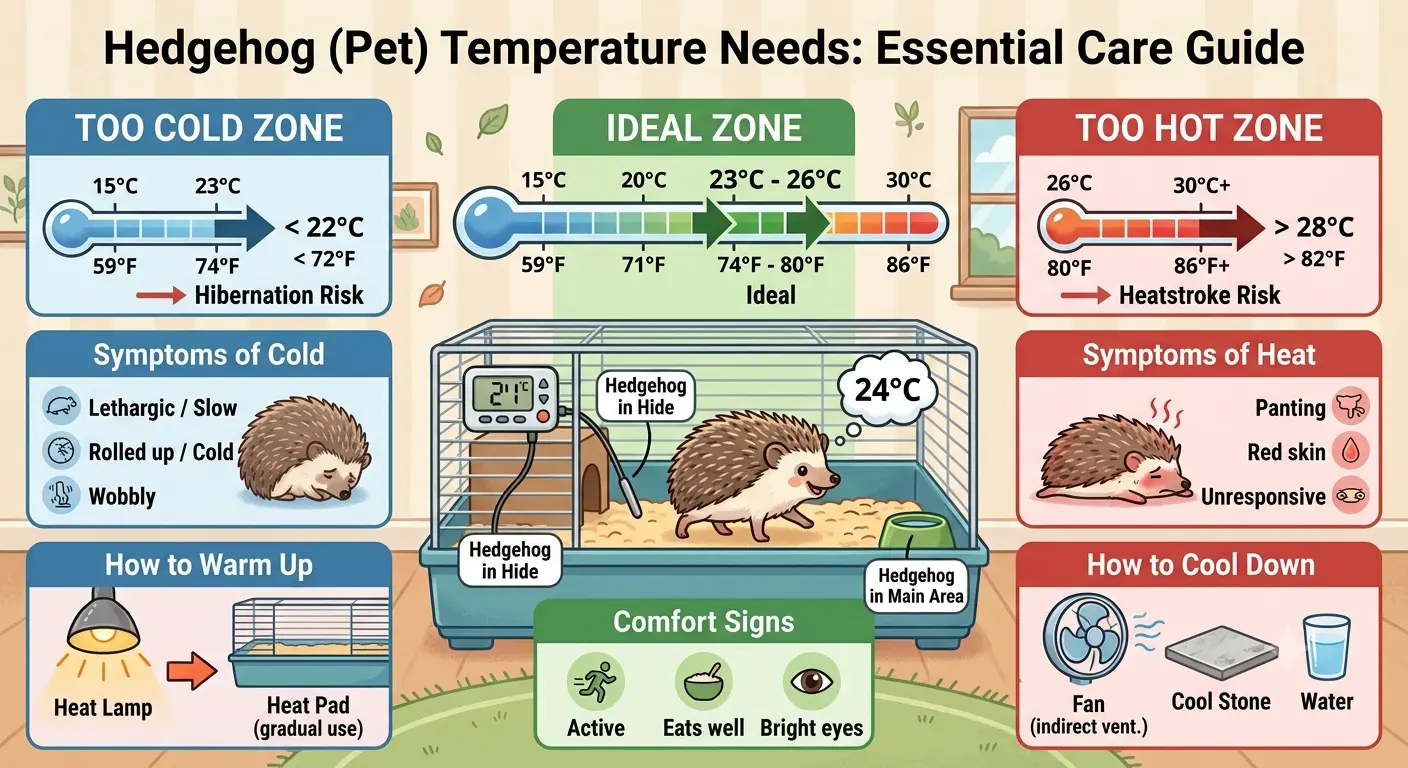
African Pygmy Hedgehogs did not. When a captive African Pygmy attempts torpor — a pseudo-hibernation response triggered by cold — it’s burning reserves it simply doesn’t have. The result is organ stress, immune collapse, and frequently, death.
68°F is the recognized danger zone. Temperatures at or below this threshold can trigger a hibernation attempt that is often fatal for captive hedgehogs without adequate fat stores.
If you suspect your pet is too cold, refer immediately to the wild hedgehog temperature guide to understand how their natural biological instincts fail them in home environments. Watch for these warning signs immediately:
- Wobbly or stumbling gait — a neurological signal of thermal distress
- Cold, firm belly — normal hedgehog skin is warm to the touch
- Extreme lethargy or unresponsiveness — not sleepiness, but shutdown
- Curling into a ball and refusing to uncurl — distinct from normal defensive balling
These symptoms demand immediate, gentle warming — not a heat blast, but gradual rewarming held against a warm body or on a regulated heat pad.
Understanding why the gradient matters, not just what the numbers are, is what separates a safe enclosure from a dangerous one — and that logic applies just as powerfully to reptiles, as we’ll explore next.
Engineering the Reptile Thermal Gradient
A reptile enclosure without a proper thermal gradient isn’t a habitat — it’s a static box that slowly compromises every biological system your animal depends on.
Unlike mammals, reptiles are ectotherms. They cannot generate body heat internally, so they rely entirely on environmental temperature to regulate digestion, immune response, and cellular metabolism.
According to the Merck Veterinary Manual, most species maintain a Preferred Optimal Body Temperature (PBT) between 77°F and 95°F — but that range is meaningless without access to a gradient.
A single fixed temperature, even if technically within that window, denies the animal the ability to thermoregulate behaviorally.
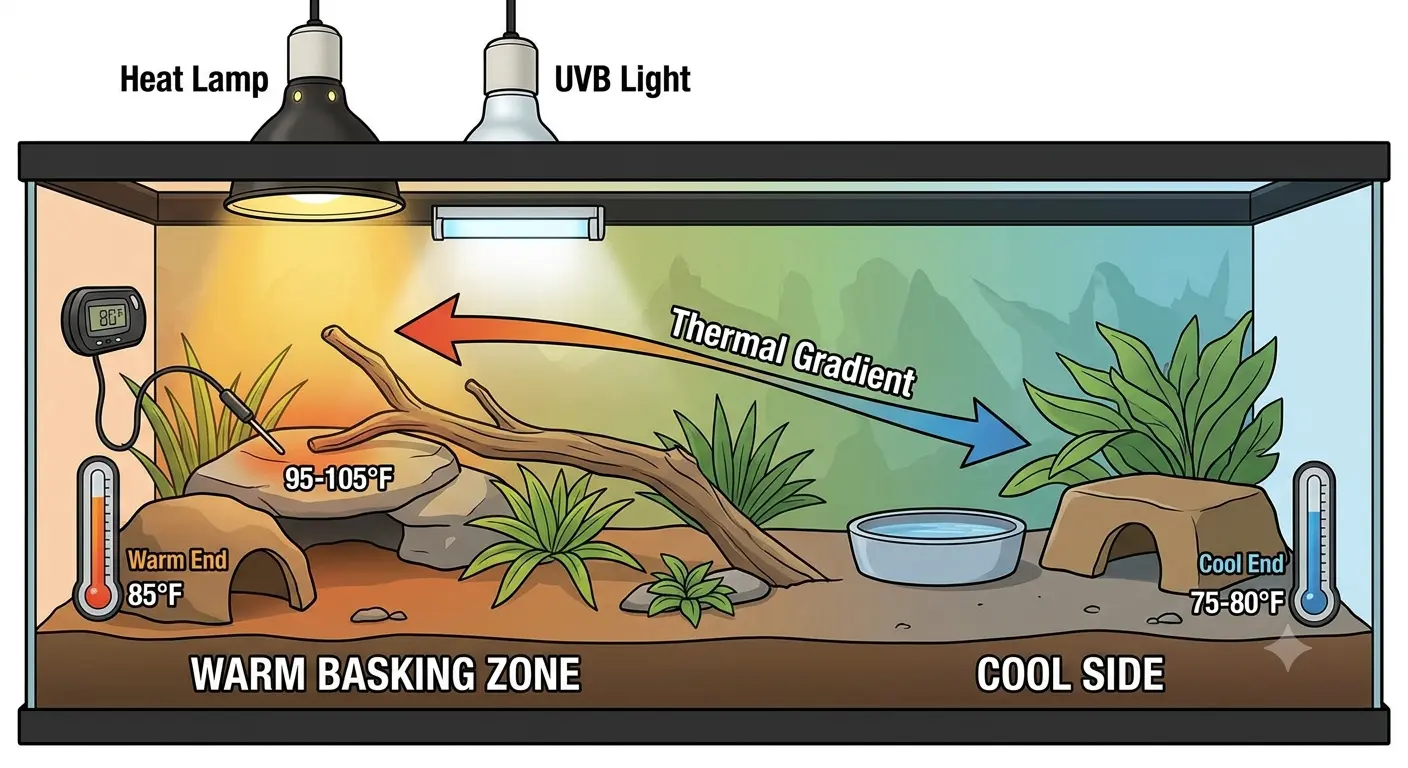
A two-zone enclosure is the engineering solution. The warm basking side — typically 88°F to 100°F depending on species — activates digestive enzymes and supports immune cell function.
The cool retreat side sits 15°F to 25°F lower, giving the animal a recovery zone and preventing chronic heat stress.
When a reptile moves between zones, it’s essentially self-medicating through temperature, a process that static heating completely eliminates.
This principle differs meaningfully from captive hedgehog temperature requirements, which center on maintaining a narrow ambient band rather than enabling gradient movement.
Reptiles need choice; hedgehogs need consistency. Understanding that distinction shapes every heating decision you make. It’s also worth exploring care setups for common exotic species to see how gradient requirements shift across different animals.
The failure mode owners encounter most often is a single under-tank heater or a centrally placed bulb that warms the whole enclosure to one uniform temperature.
That setup feels adequate on a thermometer — and looks fine to the untrained eye — but it eliminates the behavioral thermoregulation your reptile depends on to stay healthy. In the next section, we’ll look at a specific and dangerous heating product that makes this problem significantly worse.
The Danger of ‘Hot Rocks’ and Poor Thermal Analysis
Misreading how reptiles experience heat doesn’t just create discomfort — it creates irreversible physical injury, and the humble “hot rock” is the most common culprit.
Hot rocks are an engineering failure, not a heating solution. They deliver localized, unregulated contact heat with no thermostat and no ambient contribution.
The core problem is biological: reptiles possess very few cutaneous thermal receptors in their ventral skin.
Unlike mammals, which quickly register “this surface is burning me,” a reptile can rest on a dangerously hot surface for hours with no instinct to move. The tissue damage accumulates silently.
According to the Association of Reptilian and Amphibian Veterinarians, inadequate thermal regulation is the primary cause of thermal burns in captive reptiles — and hot rocks are the leading contact-heat offender.
This connects directly back to what proper reptile thermal gradient engineering actually demands: heat must come from above, replicating solar radiation, not from a superheated rock underfoot.
Overhead heating — ceramic heat emitters, deep heat projectors, or radiant heat panels — warms the air column and basking surface together, distributing energy across the enclosure the way the sun does in the wild.
A thermostat is non-negotiable with any overhead heat source. Even an overhead emitter left unregulated can push ambient temps far beyond safe limits.
Getting this right means thinking in systems — and that means the equipment you choose matters as much as the principles guiding your choices, a point worth exploring in detail next.
Building Your Thermal Environmental Home: Equipment Essentials
The right thermal equipment transforms an enclosure from a decorative box into a functioning life-support system — one that actively responds to your animal’s biological needs.
As the Journal of Exotic Pet Medicine notes, environmental engineering is not about a single set temperature but about creating a dynamic habitat that mirrors natural thermoregulatory opportunities. That distinction matters enormously in equipment selection.
Here are the four tools that make precision thermal management achievable:
| Equipment Tool | Primary Biological Function |
|---|---|
| Proportional Thermostat | Modulates heat output continuously, preventing spikes and dangerous hibernation dips. |
| Digital Hygrometer/Thermometer | Provides real-time accuracy to replace inaccurate analog stick-on dials. |
| Infrared Temperature Gun | Spot-checks basking zones, cool sides, and hidden substrate cold patches. |
| Ceramic Heat Emitter (CHE) | Produces radiant heat with zero light, maintaining nighttime gradients seamlessly. |
A well-calibrated thermal setup depends on this device hardware above all others. Digital units provide real-time accuracy your animal’s physiology actually requires.
Spot-checking the basking zone, cool side, and substrate surface takes seconds with an IR gun. It reveals cold patches and hot spots that fixed probes miss entirely.
Nocturnal species need warmth after lights-out. CHEs produce radiant heat with zero light output, maintaining the gradient through the night without disrupting natural sleep cycles.
Together, these tools form the engineering foundation that the next section distills into five core principles of lasting thermal stability.
Summary: The 5 Pillars of Thermal Stability
Effective thermal regulation within environmental engineering — whether applied to buildings or bioactive enclosures — comes down to one principle: controlled, measurable, species-appropriate conditions.
For exotic pet owners, that principle translates into five non-negotiable pillars that separate adequate husbandry from genuinely life-sustaining care.
Species-specific thermal windows are the foundation. Every animal evolved within a defined temperature range, and straying outside it triggers physiological stress.
Failing to meet proper hedgehog temperature requirements, for example, triggers hibernation attempts that can turn fatal. Knowing your animal’s precise range — not a rough estimate — is the starting point for everything else.
A thermal gradient is not optional; it’s biological infrastructure. A single static temperature removes your pet’s ability to self-regulate.
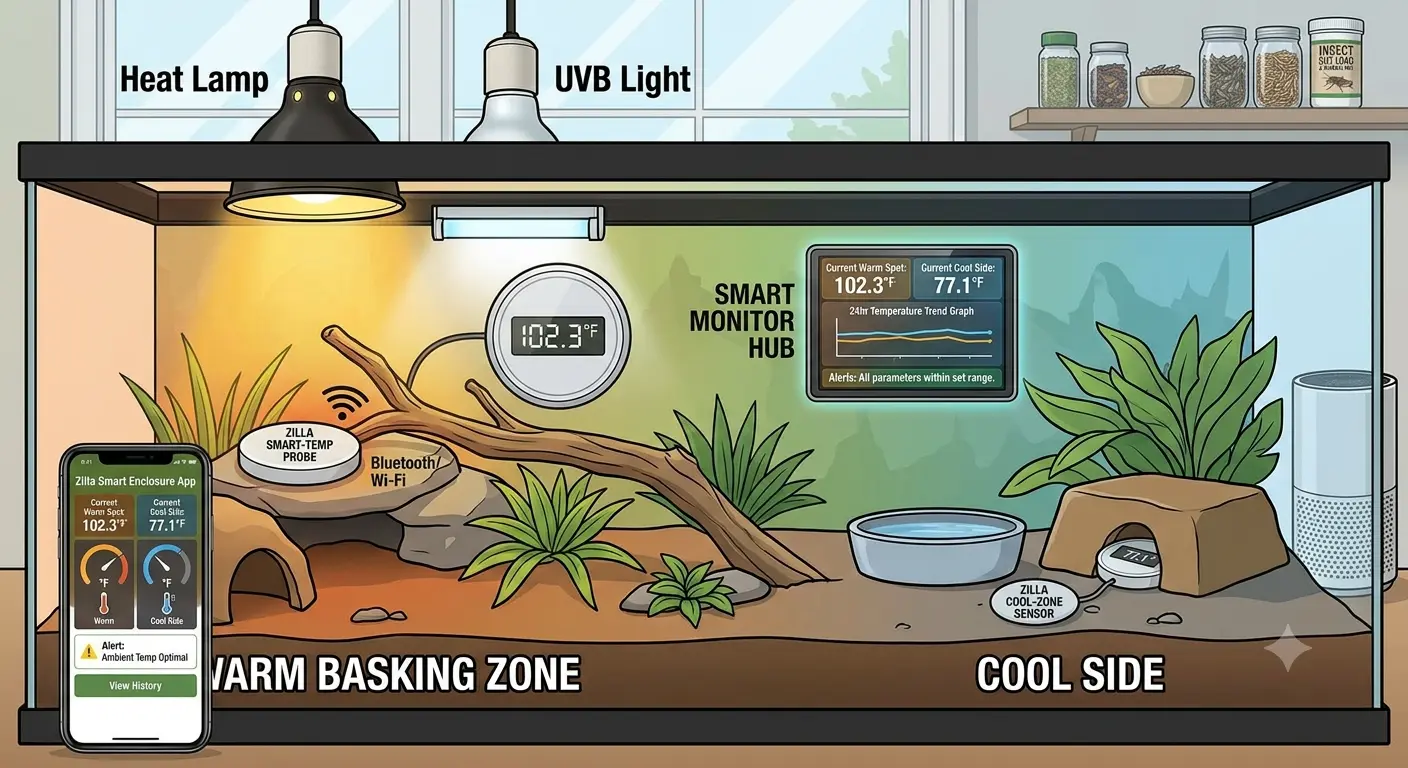
Warm and cool zones must coexist in every enclosure, allowing the animal to move instinctively toward the temperature that serves its current metabolic need.
Thermostats prevent the injuries that good intentions cause. As covered earlier, unregulated heat sources drift dangerously.
A quality thermostat holds output within a safe, stable band — protecting against burns, overheating, and the slow organ damage that accumulates silently over weeks.
Digital monitoring replaces guesswork with certainty. Analog thermometers introduce error margins that matter enormously at the scale of a small enclosure.
Digital probes placed at basking height and in the cool zone give you the accurate species health data needed to make confident adjustments.
The enclosure is a life-support system — and it should be treated as one. Every equipment choice, every temperature check, and every habitat redesign either supports or undermines your animal’s survival.
Understanding the wild context of your pet’s biology reinforces why captive environments demand such precision.
Together, these five pillars form a framework that turns passive cage ownership into active environmental stewardship. Getting the science right matters — and the next section explores exactly why that commitment, grounded in evidence-based husbandry, is the single most impactful decision an exotic pet owner can make.
Why Science-Backed Husbandry Saves Lives
Exotic pets are not forgiving of guesswork — their biology demands precision, and the gap between “close enough” and “correct” can be fatal.
Every degree of temperature variance, every missed humidity reading, and every overlooked gradient is a biological stressor your animal absorbs silently.
Research on thermoregulatory costs in ectotherms confirms that environmental drivers directly shape an animal’s metabolic burden — meaning an improperly tuned enclosure isn’t just uncomfortable, it’s physiologically damaging over time.
The most effective step any owner can take right now is to seek out species-specific care manuals rather than relying on generalized advice.
When an owner neglects core hedgehog temperature requirements, the animal risks a dangerous drop into torpor — a condition that looks like sleep but signals a life-threatening emergency most owners never see coming.
The science is clear, and the resources exist. What matters is using them.
Prioritize environmental engineering today. Treat your enclosure as the life-support system it truly is — calibrate your temperatures, validate your gradients, and audit your humidity levels before problems surface.
Exopetsecrets exists specifically to bridge the gap between peer-reviewed science and everyday exotic pet ownership, translating technical husbandry principles into actionable guidance any dedicated keeper can apply. Your animal’s longevity depends not on how much you care, but on how precisely you act.
Frequently Asked Questions (FAQ)
1. What is a thermal gradient and why do reptiles need it?
A thermal gradient is a temperature dynamic that provides a hot basking zone on one side of the enclosure and a cooler retreat on the opposite side. Ectothermic reptiles rely entirely on these microclimates to behaviorally control their body processes like digestion and immunity.
2. Can African Pygmy Hedgehogs safely hibernate?
No. Unlike wild European hedgehogs, captive African Pygmy Hedgehogs do not possess the metabolic fat stores to safely handle torpor. Cold-induced hibernation attempts lead rapidly to organ failure, immune system collapse, and death.
3. Why are heating rocks considered dangerous for exotic pets?
Hot rocks supply concentrated, localized contact heat without ambient regulation. Since reptiles have poor cutaneous thermal nerve receptors on their underbellies, they often fail to notice intense heat, causing severe thermal burns before any survival instinct triggers.
4. What are the baseline hedgehog temperature requirements?
A captive hedgehog’s environmental ambient temperature must consistently be maintained within a tight safety band between 72°F and 80°F to fully protect them from triggering a fatal hibernation response.