
Table of Contents
- The State of Wild Hedgehog Populations
- Core Terminology for Hedgehog Conservation
- The National Hedgehog Conservation Strategy
- Engineering the Hedgehog Highway
- Wilding Your Garden: Creating Natural Habitats
- Supplementary Feeding and Metabolic Health
- Safety and Predator Management
- Wild vs. Domestic: Understanding the Difference
- The Human-Hedgehog Bond: Ethical Interaction
- Related Resources and Further Reading
- Key Takeaways for Garden Conservation
- Conclusion: Becoming a Steward of the Wild
The State of Wild Hedgehog Populations
The wild hedgehog is disappearing from Britain’s countryside at an alarming rate — and residential gardens may be the last line of defense.
According to The State of Britain’s Hedgehogs 2022 report, rural hedgehog populations have declined by between 30% and 75% since 2000. Intensive farming, habitat fragmentation, and the loss of hedgerows have stripped the countryside of the foraging corridors and nesting sites these animals depend on.
What was once a common sight at dusk has become genuinely rare across large stretches of rural Britain.
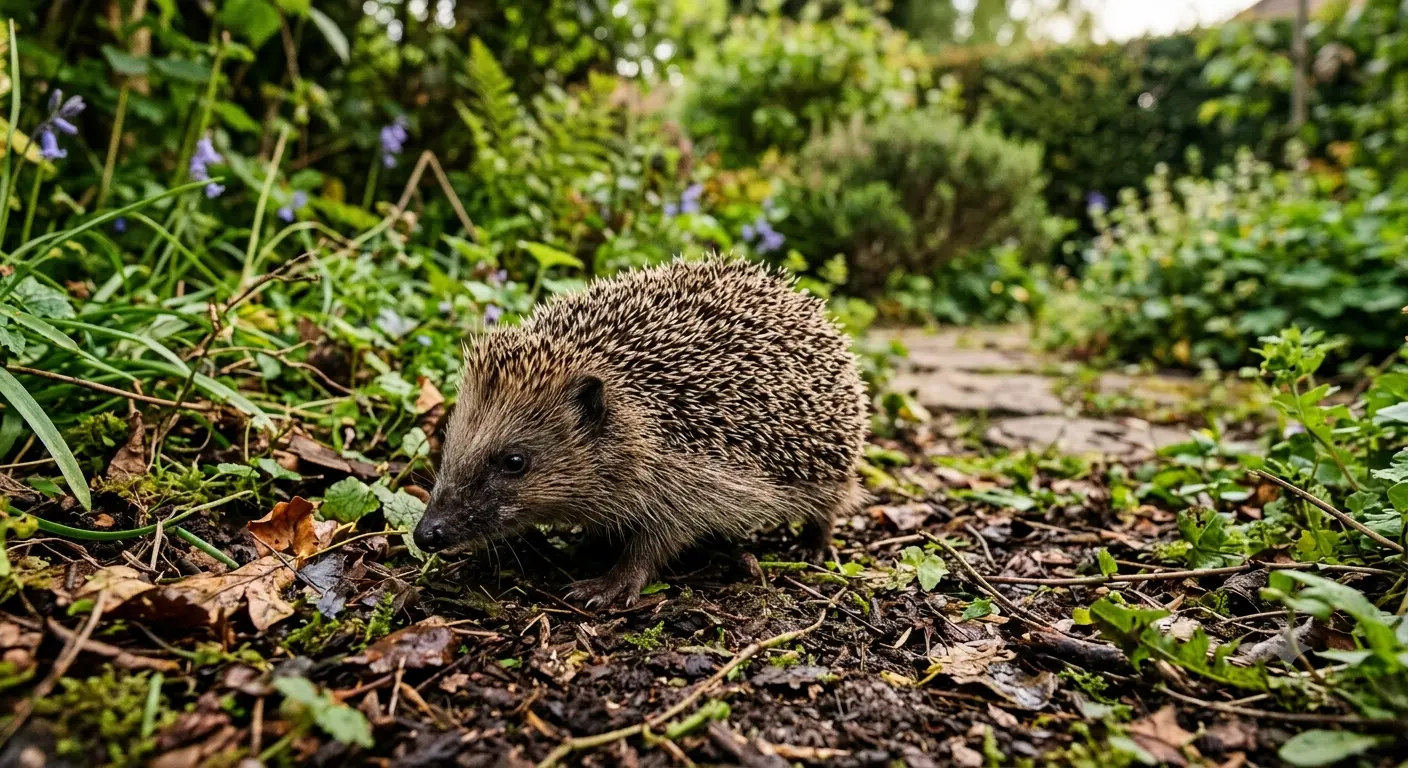
Urban and suburban gardens now represent one of the most significant refuges for hedgehog survival in the UK. Research published in PLOS ONE confirms that connected garden networks can sustain viable hedgehog populations where farmland cannot.
Unlike monoculture fields treated with pesticides, a well-managed garden offers dense leaf litter, insect-rich planting, and safe nesting opportunities — precisely the resources a hedgehog needs to feed, breed, and overwinter successfully.
This shift in where hedgehogs can thrive places an unprecedented responsibility on everyday homeowners. A single garden in isolation offers limited value.
However, when neighbors coordinate — creating linked corridors of habitat across a street or neighborhood — the cumulative effect is transformative.
This is the foundation of Garden Integration: the deliberate design of private outdoor spaces to function as connected wildlife habitat rather than isolated green islands.
Understanding how to put Garden Integration into practice starts with the language conservationists use. The next section breaks down the essential terminology — from hedgehog highways to torpor — that underpins every effective habitat strategy.
Core Terminology for Hedgehog Conservation
Understanding a handful of key terms transforms vague goodwill into purposeful action — and makes every conservation decision in your garden more deliberate and effective.
Before exploring how to grow a garden for hedgehogs into a thriving habitat, it helps to speak the same language as conservationists. The following terms appear consistently across research, wildlife guidance, and community campaigns.
Hedgehog Highway
A small gap — typically 13cm x 13cm — cut or left in garden fencing or walls to allow hedgehogs to move freely between properties.
Because hedgehogs can travel up to two miles in a single night foraging for food, connectivity between gardens is critical to their survival. A solid boundary transforms a neighborhood into an island.
Torpor
A state of dramatically reduced physiological activity — including slowed heart rate, lowered body temperature, and minimal energy expenditure — that hedgehogs enter during hibernation.
Unlike deep sleep, torpor is a metabolic strategy for surviving cold periods with scarce food. You can explore how torpor differs across hedgehog species in more depth elsewhere on this site.
Wilding
The practice of allowing sections of land — including garden corners — to return to a naturalistic, unmanaged state.
Wilding encourages native plants, leaf litter accumulation, and insect populations to flourish, all of which directly support hedgehog foraging and nesting needs.
Insectivore
A dietary classification describing animals whose primary food source is insects and invertebrates. Hedgehogs are obligate insectivores, requiring high-protein diets and chitin — the structural compound found in insect exoskeletons — for metabolic health.
A garden rich in invertebrates is, functionally, a hedgehog pantry.
These four concepts underpin virtually every practical recommendation in hedgehog conservation — from neighborhood-scale connectivity projects to the national strategies now shaping policy across Britain.
The National Hedgehog Conservation Strategy
Protecting the hedgehogs in the wild requires far more than individual goodwill — it demands a coordinated, landscape-scale response that no single gardener or organization can deliver alone.
The UK’s first-ever National Hedgehog Conservation Strategy represents exactly that kind of institutional commitment.
Launched to coordinate efforts across 30 diverse organizations — from wildlife trusts to local councils — the strategy marked a decisive shift in how conservationists think about hedgehog recovery.
Rather than celebrating isolated garden improvements, it reframes the challenge as one of landscape connectivity: how individual patches of habitat link together to form viable corridors that hedgehogs can actually navigate.
The strategy’s three primary goals reflect this broader ambition:
- Halt the decline of hedgehog populations across both urban and rural landscapes by addressing key mortality drivers, including road traffic, agricultural intensification, and habitat fragmentation.
- Increase connectivity between hedgehog habitats at a neighborhood and landscape scale, prioritizing access routes over isolated garden improvements.
- Build public and institutional engagement by recruiting homeowners, local authorities, and land managers as active participants rather than passive bystanders.
The British Hedgehog Preservation Society (BHPS) plays a central role in translating this strategy into practical action.
Alongside partner organizations, the BHPS drives public education, supports research, and funds initiatives that connect what happens in domestic gardens to measurable population-level outcomes.
It’s a reminder that the humble hedgehog-friendly garden features carry genuine conservation weight when multiplied across thousands of homes.
However, strategy without implementation changes nothing. The real test lies in how individual homeowners respond — which is precisely where physical garden design becomes critical.
That starts with one deceptively simple question: how do hedgehogs actually move between gardens in the first place?
Engineering the Hedgehog Highway
A single fence gap, cut to the right dimensions, can unlock an entire neighborhood for wild hedgehogs — and it costs nothing but a saw and a conversation.
Connectivity is the cornerstone of effective hedgehog conservation. A hedgehog typically roams one to two miles each night foraging for food, which means the boundaries of your garden are never its final destination.
According to Hedgehog Street (a joint project by PTES and BHPS), the minimum gap required to create a functional Hedgehog Highway is 13cm x 13cm (5 inches square) at the base of a fence or wall.
That precise measurement matters — too small and a hedgehog simply cannot pass through; too large and it may admit predators.
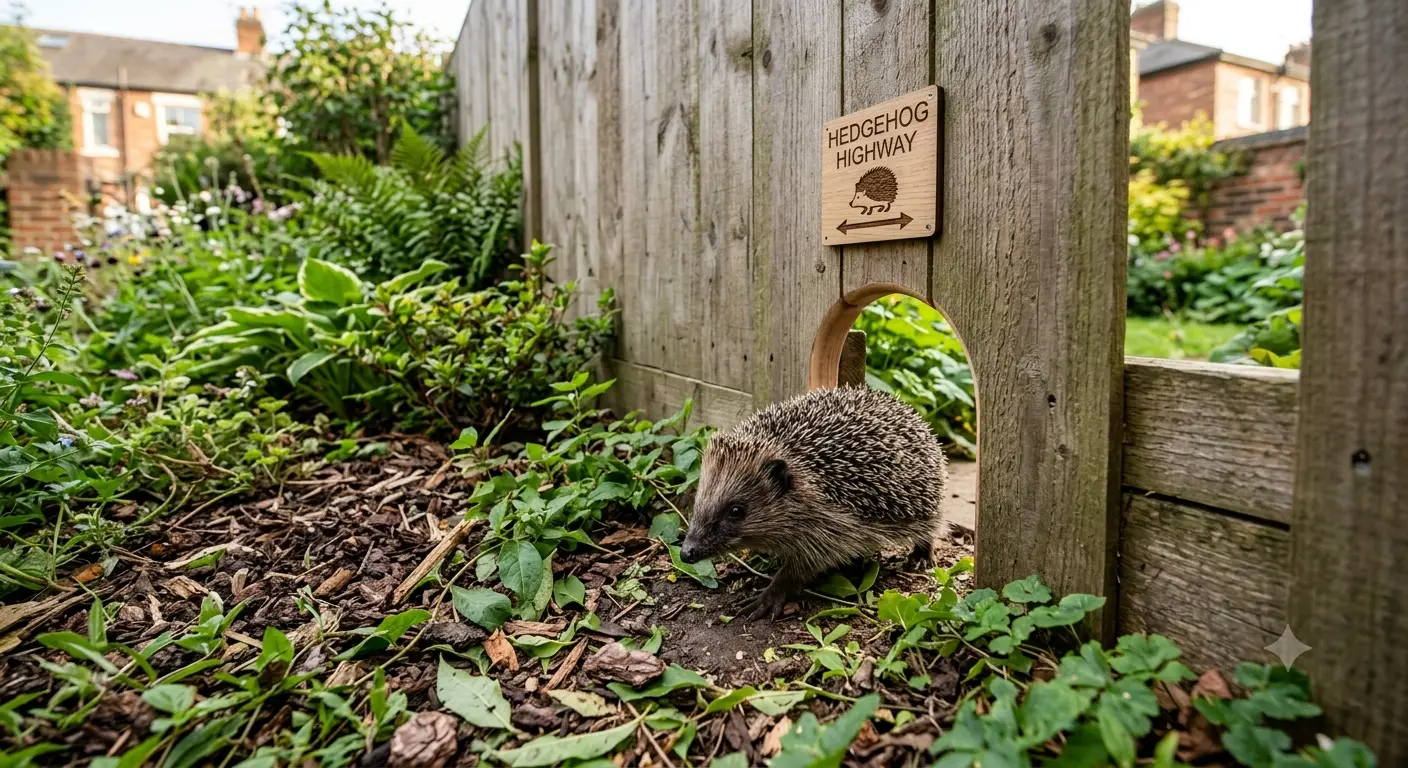
Garden size is almost irrelevant if that garden functions as an island. Research published in PLOS ONE confirms that landscape-scale connectivity — a network of linked gardens — delivers population-level benefits that no single, perfectly managed plot can achieve alone.
A modest yard with four working access points outperforms a sprawling, well-planted garden surrounded by solid fencing on every side.
Creating that network means working with neighbors, which is where many well-intentioned plans stall. The practical steps are straightforward:
- Map your boundaries. Identify every fence panel, wall, and gate that separates your garden from adjacent properties.
- Cut or drill the gap. A jigsaw handles timber panels; a masonry bit and chisel works for brick. Place the gap at ground level, not raised.
- Mark it clearly. A small tile or painted stone signals the gap’s location to neighbors and avoids accidental blocking.
- Register it. Add your highway to the Hedgehog Street map to contribute to national connectivity data.
Pro Tip — neighbor communication: Frame the conversation around shared benefits. Most people respond positively when they learn a single small hole protects a species that controls garden pests naturally.
A printed leaflet from the British Hedgehog Preservation Society left in a mailbox often does the opening work for you.
One practical caveat: solid brick garden walls require more effort than timber panels, and listed-property restrictions occasionally apply.
In those cases, a gap beneath a gate or a purpose-built tunnel through a raised bed achieves the same result. The goal is always uninterrupted ground-level movement.
With access corridors in place, attention naturally shifts to what wild hedgehogs actually find — or fail to find — once they move between gardens.
That brings us to the habitat quality inside your boundaries, starting with the overgrown, untidy corners that look like neglect but function like a five-star hedgehog hotel.
Wilding Your Garden: Creating Natural Habitats
A garden transformed into layered, messy abundance does more for hedgehog survival than any single conservation product on the market.
Complementing the connectivity work covered in the previous section, habitat quality within each garden patch is equally critical.
Any effective hedgehog conservation strategies must include the domestic garden as a productive foraging and nesting environment — not merely a corridor.
As Fay Vass, Chief Executive of the British Hedgehog Preservation Society, puts it: “The most important thing people can do is to provide a variety of habitats in their gardens, such as log piles, compost heaps, and overgrown areas.”
Log piles and compost heaps are the two highest-value features you can add. Rotting wood hosts beetles, centipedes, and earthworms — exactly the invertebrate prey hedgehogs depend on.
A stack of untreated logs tucked into a shaded corner creates both a feeding station and a potential day-rest site.
Compost heaps add warmth and year-round invertebrate activity, though gardeners should check thoroughly before turning them, since hedgehogs occasionally nest inside.
Guidance from the RHS (Royal Horticultural Society) on garden wildlife habitats reinforces that even small features deliver measurable biodiversity gains.
Manicured lawns are ecological dead zones for hedgehogs. Short-mown grass offers almost no invertebrate life, no shelter, and nowhere to forage effectively.
Research consistently shows that highly managed garden surfaces — clipped edges, bare soil, ornamental gravel — contribute to the habitat fragmentation already pressuring wild populations.
Reducing mown areas by even 20–30% can significantly increase ground-dwelling invertebrate density.
Creating a dedicated “wild zone” requires minimal effort: stop mowing one corner, allow leaf litter to accumulate, and let native grasses establish.
This untidy patch becomes a hunting ground rich in beetles, slugs, and moths. Unlike captive animals such as African Pygmy Hedgehogs kept in enclosures, wild European hedgehogs need real foraging complexity to maintain healthy body weight — a factor that becomes especially critical as autumn approaches and they must reach hibernation weight to survive.
Supplementary Feeding and Metabolic Health
What a hedgehog eats in autumn can determine whether it wakes up in spring — supplementary feeding is one of the most direct interventions any gardener can make.
Getting the right food into your hedgehog habitat setups matters enormously as the season shifts.
According to the RSPCA, hedgehogs must reach a minimum weight of 450g–600g before hibernation to have a realistic chance of survival.
Juveniles born late in the season are especially vulnerable — they simply haven’t had enough foraging time to accumulate the fat reserves they need.
The single most damaging feeding myth is that milk and bread are suitable offerings. Both are actively harmful: lactose causes severe digestive distress, and bread provides empty calories with no nutritional value at a time when every calorie must count.
Meat-based wet cat or dog food — ideally in jelly rather than gravy — closely mirrors a hedgehog’s natural insect-heavy diet and supports the rapid weight gain juveniles need.
For a broader look at what hedgehogs can safely eat, the principles of balanced nutrition apply whether you’re feeding wild visitors or captive animals.
| Safe Foods | Foods to Avoid | Why |
|---|---|---|
| Meat-based wet cat/dog food | Cow’s milk | Causes diarrhea and dehydration |
| Kitten biscuits (low fat) | Bread | Zero nutritional value |
| Mealworms (in moderation) | Mealworms in excess | Metabolic bone disease risk |
| Fresh water | Flavored water/milk substitutes | Unnecessary additives |
| Unseasoned cooked chicken | Fish-based cat food | Too high in certain oils |
Fresh water deserves equal emphasis — hedgehogs are prone to dehydration, particularly during dry summers and the weeks immediately before hibernation.
A shallow dish, cleaned daily, positioned near a feeding station but away from main pathways, gives visiting animals consistent access.
The habitat improvements covered in previous sections create the conditions for hedgehogs to arrive; consistent, correctly chosen supplementary food gives them the metabolic foundation to thrive — and to survive the hazards that a well-intentioned garden can still present.
Safety and Predator Management
A hedgehog-friendly garden isn’t just about food and shelter — eliminating hidden hazards can be the difference between a hedgehog thriving and one that never makes it through the night.
Having established how supplementary feeding supports metabolic health through autumn, it’s equally important to address the physical dangers waiting in even the most well-intentioned gardens. Hazard removal is practical conservation at its most direct.
Garden Hazards and Solutions:
- Fox competition at feeding stations: Foxes are natural competitors; providing separate feeding stations at different garden heights or locations can reduce direct conflict, allowing hedgehogs to feed without interruption, as noted in Exopets Conservation Analysis.
- Ponds and water features: A hedgehog that falls in cannot climb smooth vertical edges; install a gently sloping ramp or a textured escape route on at least one side.
- Netting and fruit cage mesh: Loose netting left at ground level can entangle legs and spines fatally; raise netting above 12 inches when not actively in use or switch to rigid framing.
- Slug pellets and pesticides: Metaldehyde-based pellets and organophosphate sprays are acutely toxic; use iron phosphate alternatives or physical barriers instead.
- Strimmers and lawn mowers: Hedgehogs shelter in long grass; always check before mowing, particularly in spring and late autumn when individuals may be nesting.
- Bonfires and compost heaps: These mimic ideal hibernation sites; always disturb a bonfire pile before lighting and fork compost carefully before turning.
- Garden netting around vegetables: Strawberry netting with openings smaller than 2 inches can trap snouts; opt for purpose-built crop cages with solid frames.
According to the British Hedgehog Preservation Society, proactive hazard management combined with habitat corridors delivers significantly greater conservation outcomes than either measure alone.
Understanding these physical dangers naturally prompts a broader question about the animals themselves — specifically, the critical distinction between the wild hedgehogs sharing our gardens and the very different species sometimes kept as exotic pets.
Wild vs. Domestic: Understanding the Difference
Not every hedgehog belongs in a garden — and not every hedgehog belongs in a home. Confusing wild European hedgehogs with their domesticated counterparts is a surprisingly common mistake, one with real conservation and legal consequences.
The two species are biologically distinct. The European Hedgehog (Erinaceus europaeus) is a native UK wildlife species, protected under the Wildlife and Countryside Act 1981, which makes it illegal to intentionally kill, injure, or take one from the wild.
The African Pygmy Hedgehog (Atelerix albiventris) is the species sold as an exotic pet in the US and UK — selectively bred over decades for temperament and captive conditions.
| Wild Species (E. europaeus) | Domestic Species (A. albiventris) |
|---|---|
| Native to Europe | Native to sub-Saharan Africa |
| Protected by UK law | Legal to own in most US states |
| Full thermal regulation for hibernation | Lacks hibernation capability; cold-induced torpor is dangerous |
| Free-roaming; covers 1–2 km per night | Adapted to enclosures with enrichment |
| Diet: wild invertebrates, berries, carrion | Diet: formulated kibble, insects, fresh food |
| Cannot be legally kept as a pet (UK) | Bred specifically for captivity |
According to Exopetsecrets Care Manuals, domesticated African Pygmy hedgehogs lack the thermal regulation capabilities of their wild European counterparts — meaning a wild hedgehog placed in captive conditions, or a domestic one released outdoors, faces serious physiological risk.
Wild hedgehogs must never be kept as pets. Beyond legality, the stress of captivity suppresses immune function, disrupts natural foraging behavior, and prevents successful reintegration into the wild.
If you encounter a hedgehog that appears injured or orphaned, the correct response is always to contact a wildlife rehabilitator — a subject the next section addresses through the lens of responsible, ethical human-hedgehog interaction.
The Human-Hedgehog Bond: Ethical Interaction
Wild hedgehogs don’t form bonds with humans — but that doesn’t mean meaningful, ethical coexistence is impossible. Understanding the boundary between connection and interference is what separates responsible garden stewardship from well-intentioned harm.
Do hedgehogs recognize humans? According to WildCRU Ecology Research, hedgehogs are solitary animals primarily driven by scent.
While they may habituate to a regular human presence over time — becoming less likely to ball up defensively — this is tolerance, not recognition. They don’t form social bonds the way domestic pets do.
A hedgehog that appears “tame” near a food station is responding to a reliable scent cue, not displaying affection.
Should you handle a wild hedgehog? In most cases, no. Handling introduces human scent, causes stress, and risks transferring zoonotic pathogens in both directions.
The ethically sound approach is observation from a distance — ideally using a dim red-tinted light, which disrupts hedgehog activity less than white light.
If you’re curious about whether hedgehogs make suitable companions, African Pygmy hedgehogs are a legally kept domestic species — wild European hedgehogs are not an appropriate substitute.
When does a wild hedgehog need help? Intervention is warranted only in specific circumstances:
- Visible injury — open wounds, limping, or obvious physical trauma.
- Daytime activity — healthy hedgehogs are nocturnal; daytime roaming often signals illness or desperation.
- Wobbly or circling movement — a classic sign of neurological distress or lungworm.
- Underweight juveniles in fall — hoglets under 300g before winter will not survive hibernation.
In these cases, contact the British Hedgehog Preservation Society’s helpline or a local wildlife rehabilitator before attempting to move the animal.
Use thick gloves, place the hedgehog in a high-sided box with ventilation, and keep it warm and dark until professional help is available.
For deeper dives into hedgehog behavior, habitat data, and citizen science tools, the next section pulls together the most authoritative resources available.
Related Resources and Further Reading
The most effective conservation action combines reliable information with active community participation — the resources below connect you to both, whether you’re optimizing a garden habitat or contributing to national population data.
Deepening your understanding of hedgehog biology strengthens every practical decision covered throughout this guide.
If you also keep or are considering a domestic hedgehog, the distinction between wild and captive care matters enormously — explore feeding guidance for captive exotic hedgehogs to understand how dietary needs diverge sharply from those of free-roaming wildlife. Applying wild-animal logic to a pet, or vice versa, can cause real harm.
Citizen science is one of the most powerful tools in hedgehog conservation. Hedgehog Street, a joint initiative between the People’s Trust for Endangered Species and the British Hedgehog Preservation Society, uses community-submitted sightings to map national population trends — data that directly informs conservation policy. Recording even a single confirmed sighting through their platform contributes to this evidence base.
For garden-specific guidance backed by ecological research, the following curated links provide authoritative next steps:
- RHS: How to Help Hedgehogs in Your Garden — Practical video guidance from the Royal Horticultural Society covering habitat features and planting choices.
- WWF: 5 Ways to Help Hedgehogs — A concise action checklist suitable for any garden size.
- WildCRU: Ecology and Conservation of European Hedgehogs — Peer-reviewed research on population dynamics for readers who want the science.
- PTES Conservation Strategy 2015–2025 — The foundational strategic document guiding UK-wide recovery efforts.
- RHS National Hedgehog Conservation Strategy Overview — Summarizes how gardens fit into the broader national framework.
Key Takeaways for Garden Conservation
One garden is a stop; ten connected gardens are a habitat — and that single principle drives everything covered throughout this guide.
Conservation is ultimately a community effort, and the actions below distill the most impactful steps any gardener can take right now:
- Cut a 13cm highway gap in every fence panel or wall boundary — connectivity is the single highest-leverage intervention available to individual homeowners.
- Choose natural habitat features over artificial ones — log piles, native shrub borders, and leaf-litter zones outperform plastic feeding stations as long-term shelter solutions.
- Use supplementary feeding strategically — offer high-protein, wet cat food only during late autumn to help hedgehogs reach their critical pre-hibernation weight, then scale back as spring arrives.
- Keep your hands to yourself — a healthy wild hedgehog seen foraging at dusk needs no human intervention; handling introduces stress and disrupts natural behavior patterns.
Diverse, layered gardens consistently outperform manicured lawns as hedgehog habitat, according to research reviewed by the Wildlife Conservation Research Unit.
Structural variety — from ground-level debris to mid-story shrubs — supports the full range of invertebrate prey hedgehogs depend on. Artificial feeders and purpose-built houses add value only when natural foraging opportunities are already present.
In practice, the no-handling rule is where well-meaning gardeners most frequently slip. Resistance to intervention feels counterintuitive when an animal appears vulnerable, but WWF‘s hedgehog guidance is clear: contact should be reserved for animals showing obvious distress — daytime activity, visible injury, or disorientation.
Ethical restraint is itself a conservation act. These four principles — connectivity, natural habitat, targeted feeding, and non-interference — form the practical foundation of everything this guide has explored.
Applying even one of them moves your outdoor space meaningfully closer to the broader network of habitat that hedgehog populations need to recover. What follows is an invitation to take that commitment further.
Conclusion: Becoming a Steward of the Wild
Every garden decision — a gap in a fence, a pesticide skipped, a log pile built — ripples outward into a wider web of biodiversity that no single conservation agency can maintain alone.
Individual action matters more than it might seem. Research published in PLOS ONE confirms that coordinated garden-level changes across neighborhoods produce measurable population gains for hedgehogs — species whose decline mirrors pressures felt by countless other urban-adapted wildlife.
When enough households commit to the same principles covered throughout this guide, fragmented green spaces transform into functioning habitat corridors. That shift happens one hole-in-a-fence at a time.
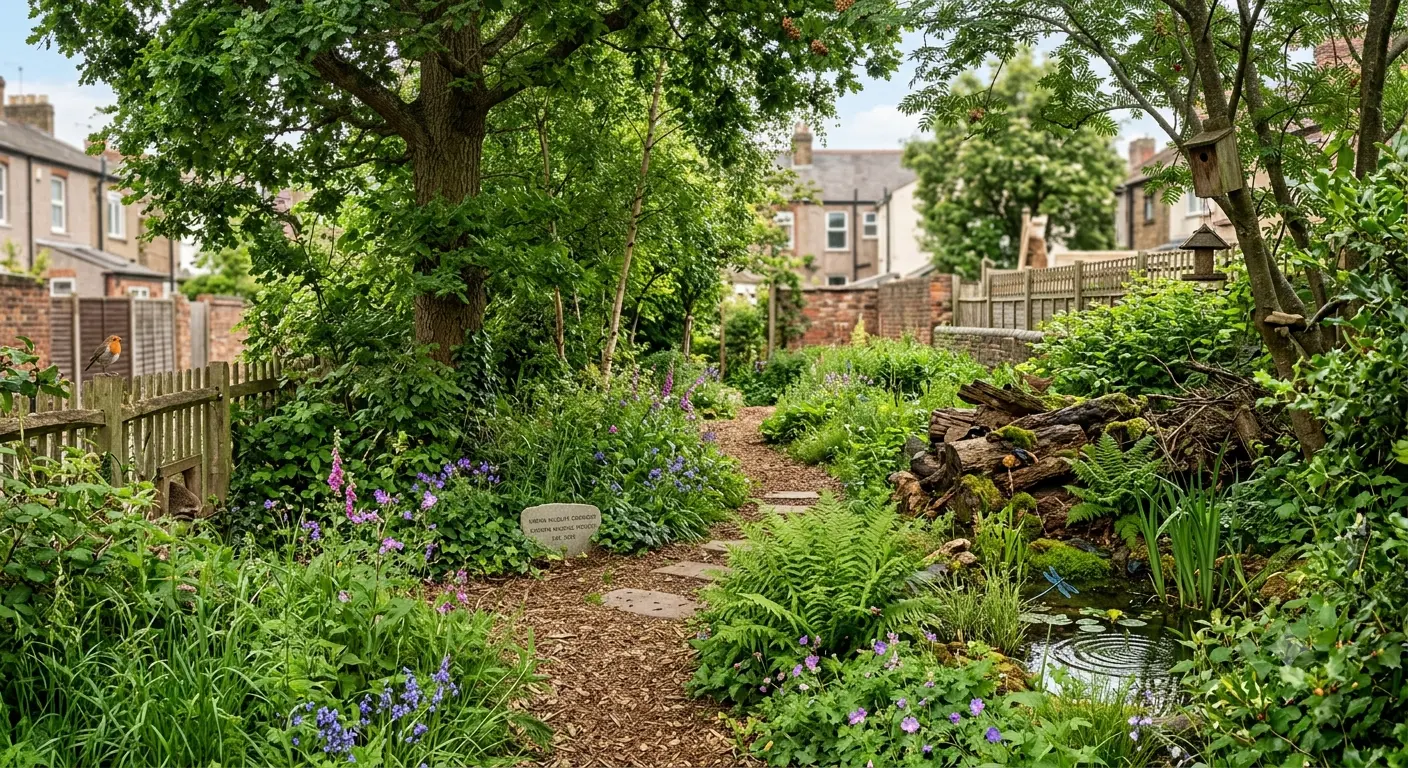
The “hedgehog highway” you build is the most shareable conservation act in your neighborhood. Photographing your gap, tagging your location on citizen science platforms, and encouraging adjacent households to connect their gardens turns a private project into public infrastructure for wildlife.
Share your progress — even a single before-and-after photo posted to a local community group can inspire five more households to act. Conservation momentum is contagious, and visible examples outperform any amount of written advice.
This guide exists at the intersection that ExoPetSecrets is built to occupy. As the mission statement puts it, “exotic pet owners have a unique set of skills that make them the perfect advocates for wild species conservation.”
The observation skills, habitat knowledge, and species empathy developed through keeping animals like African pygmy hedgehogs translate directly into more effective wild-hedgehog stewardship. Caring for one hedgehog teaches you to care about all of them.
Wild hedgehog conservation is not a specialist pursuit — it is a daily practice available to anyone with outdoor space. Start with what this guide has shown you, then keep learning.
Subscribe to the ExoPetSecrets conservation newsletter to receive seasonal habitat tips, citizen science opportunities, and updates on hedgehog population research delivered straight to your inbox.
For more comprehensive expert guides, breed profiles, and seasonal tips on caring for these prickly creatures, be sure to explore our dedicated hedgehog resource hub at Hedgehog Haven.