
Few things alarm a reptile keeper quite like looking into an enclosure and seeing a stark, jet-black throat. For beginners, witnessing a Bearded Dragon’s Beard Black transformation can induce sudden, intense panic. It looks menacing, dramatic, and deeply concerning to anyone invested in their pet’s daily well-being.
However, before you rush to your local exotic veterinarian, take a deep, reassuring breath. This sudden physical manifestation is actually one of your reptile’s primary tools for communicating with the outside world, revealing vital clues about its emotional and physical baseline.
In the reptile world, color shifts serve as a highly complex language system that conveys emotions, biological needs, and physical boundaries. By learning to decode why a Bearded Dragon’s Beard Black display happens, you can build a stronger bond with your scaly companion and optimize their husbandry.
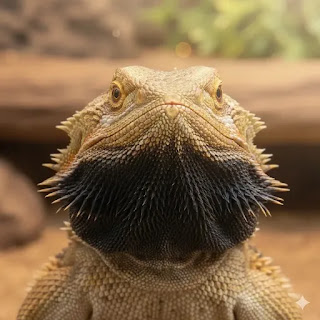
1. Bearded Dragon’s Beard Black Triggers: Understanding Stress and Fear
The most frequent cause of a localized physical color change is environmental stress or sudden fear. Because these reptiles are highly sensitive to subtle variations in their surrounding environment, they react quickly to anything unfamiliar by shifting their underlying pigmentation patterns.
When a reptile encounters a situation it cannot fully comprehend, its default survival mechanism is to look intimidating. This biological defense protocol triggers an immediate rush of melanin to the vascular tissues located underneath the throat scales, causing a Bearded Dragon’s Beard Black response.
Bearded Dragon’s Beard Black Causes: Environmental Shifts and Alterations
A new piece of living room furniture, a different room layout, or even distant loud noises can trigger a fear response. To a tiny reptile, a shifting environment signals potential danger, causing an immediate reaction to protect its personal space.
Bearded Dragon’s Beard Black Reactions: Domestic Relocation Anxiety
Sudden relocations or moving the enclosure to a busier household area often compounds this anxiety. When daily visual stimulation increases beyond their comfort threshold, a defense routine initiates, stabilizing the darkening tissue until they adapt.
Bearded Dragon’s Beard Black Stances: The Glass Tank Reflection Paradox
Many domestic dragons struggle constantly with their own reflection in the tank glass, foolishly perceiving it as a rival intruder. If they see their own shadow bouncing off the glass pane, they will instantly initiate a defensive display to defend their physical territory.
Bearded Dragon’s Beard Black Postures: Predator Instincts and Domestic Coexistence
If they spot a domestic dog or cat peering into their enclosure, instinct takes over completely. They will aggressively puff out their throat and initiate a performance to appear significantly larger and more threatening to the perceived mammalian predator.
2. Bearded Dragon’s Beard Black Signals: Territorial Dominance Explained
Bearded dragons are naturally solitary, fiercely independent, and highly territorial creatures by default. In their native Australian wild habitats, their day-to-day survival depends directly on successfully defending their chosen feeding and basking spaces from competitive mature conspecifics.
In captivity, these ancestral survival traits remain fully intact within their genetic makeup. Even without wild competition, your domestic pet will use these communication cues to declare ownership over its surrounding environment and warn away any potential structural encroachers.
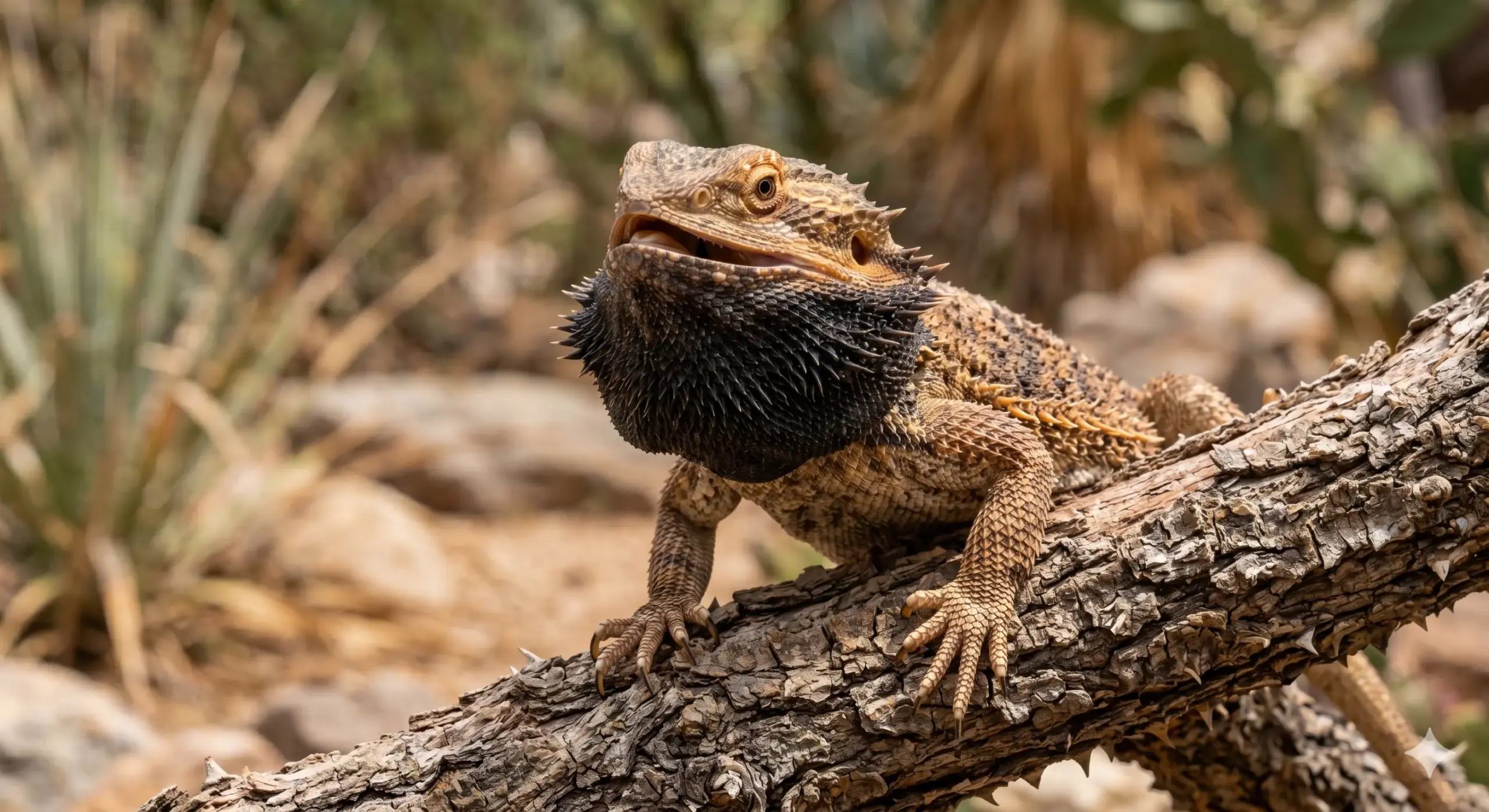
Bearded Dragon’s Beard Black Displays: The “This is My Spot” Visual Threat
If a reptile feels that its personal space is being encroached upon by humans or other animals, it utilizes a darkened throat. This unmistakable posture serves as a non-verbal warning that says trespassers are absolutely not welcome within its designated territorial zone.
Bearded Dragon’s Beard Black Appearances: Rhythmic Head Bobbing Sequences
This unique physical behavior is almost always accompanied by aggressive, rhythmic head bobbing patterns. A rapid, violent head bob combined with the dark throat signals pure dominance, whereas a slow, submissive arm wave typically indicates complete compliance and peaceful intentions.
Important Herpetological Note: It is universally recommended by veterinary experts to keep adult dragons in completely separate enclosures. Forcing them to cohabitate causes constant territorial stress, often triggering a chronic state, psychological exhaustion, and severe physical injuries over time.
3. Bearded Dragon’s Beard Black Functions: Thermoregulation Mechanisms
Since they are ectothermic organisms, these unique reptiles rely entirely on external environmental heat sources to regulate their core body temperature. They do not possess the internal metabolic mechanisms required to generate their own body warmth efficiently without external environmental assistance.
Therefore, managing skin pigmentation becomes a critical physiological tool for physical survival. By modulating the shade of their skin, they can control exactly how quickly or slowly they absorb radiant energy from their overhead artificial basking setups during the day.
Bearded Dragon’s Beard Black Status: The Core Thermal Physics of Dark Shades
Basic physics dictates that darker colors absorb radiant thermal energy significantly faster than lighter, reflective shades. When a reptile needs to raise its internal temperature quickly, its nervous system signals melanin cells to expand, creating a functional pattern to maximize absorption.
Bearded Dragon’s Beard Black Phases: Morning Basking and Metabolic Activation
You will frequently notice a distinct coloration change specifically during the early morning hours. They are essentially charging their biological batteries, darkening their skin tissue to absorb heat rapidly and kickstart their sluggish morning metabolism for the long day ahead.
Bearded Dragon’s Beard Black Issues: Enclosure Temperature Mapping
This natural phenomenon highlights the critical importance of maintaining a highly accurate thermal gradient across your enclosure. If a transformation persists due to low temps, providing clear hot and cool zones allows your reptile to adjust its body as required.
4. Bearded Dragon’s Beard Black Looks: Mating Season and Hormonal Shifts
If you own an intact male, internal hormones can be the primary biological driver behind a frequent dark throat. As seasons shift, wild instincts urge these animals to find a suitable mate, triggering noticeable behavioral changes that can surprise inexperienced keepers.
During these specific seasonal windows, your pet might seem unusually hyperactive, hyper-vigilant, or easily agitated. This is a completely normal phase of reptile development where seeing this dark coloration phase requires patience and minimal handling from the owner.
Bearded Dragon’s Beard Black Stances: Breeding Display Dynamics
During the spring breeding season, healthy males will continuously display a dark, puffed-out throat structure to impress potential females. This dramatic alteration is meant to showcase vitality, genetic strength, and structural maturity to any observing female dragons residing nearby.
Bearded Dragon’s Beard Black Moods: Courtship Impulses and Wild Instincts
This intense behavior is a deeply hardwired biological drive that manifests even if no female is present anywhere in the room. This shifting appearance is simply their natural evolutionary way of demonstrating that they are healthy, strong, and fully prepared to propagate the species.
5. The Human Experience: Life with a Grumpy Dragon
I remember one rainy Tuesday morning vividly. I walked up to the glass enclosure, holding a fresh bowl of chopped mustard greens and crunchy dubia roaches. My little buddy, Apollo, was sitting stubbornly on his favorite piece of desert driftwood. He looked straight at me. Instantly, his throat ballooned outward, shifting from a soft orange cream to a deep, charcoal black color within seconds. It was jarring.
My heart sank instantly because I thought I had broken our bond completely. I wondered if he suddenly hated me. But reptile keeping teaches you patience. It forces you to slow down and listen to a language that doesn’t use words at all. I realized he was just having an off morning because the room was chilly. We sat together quietly. I adjusted his basking light. Slowly, the dark ink dissolved from his throat, revealing his normal gentle colors once again.
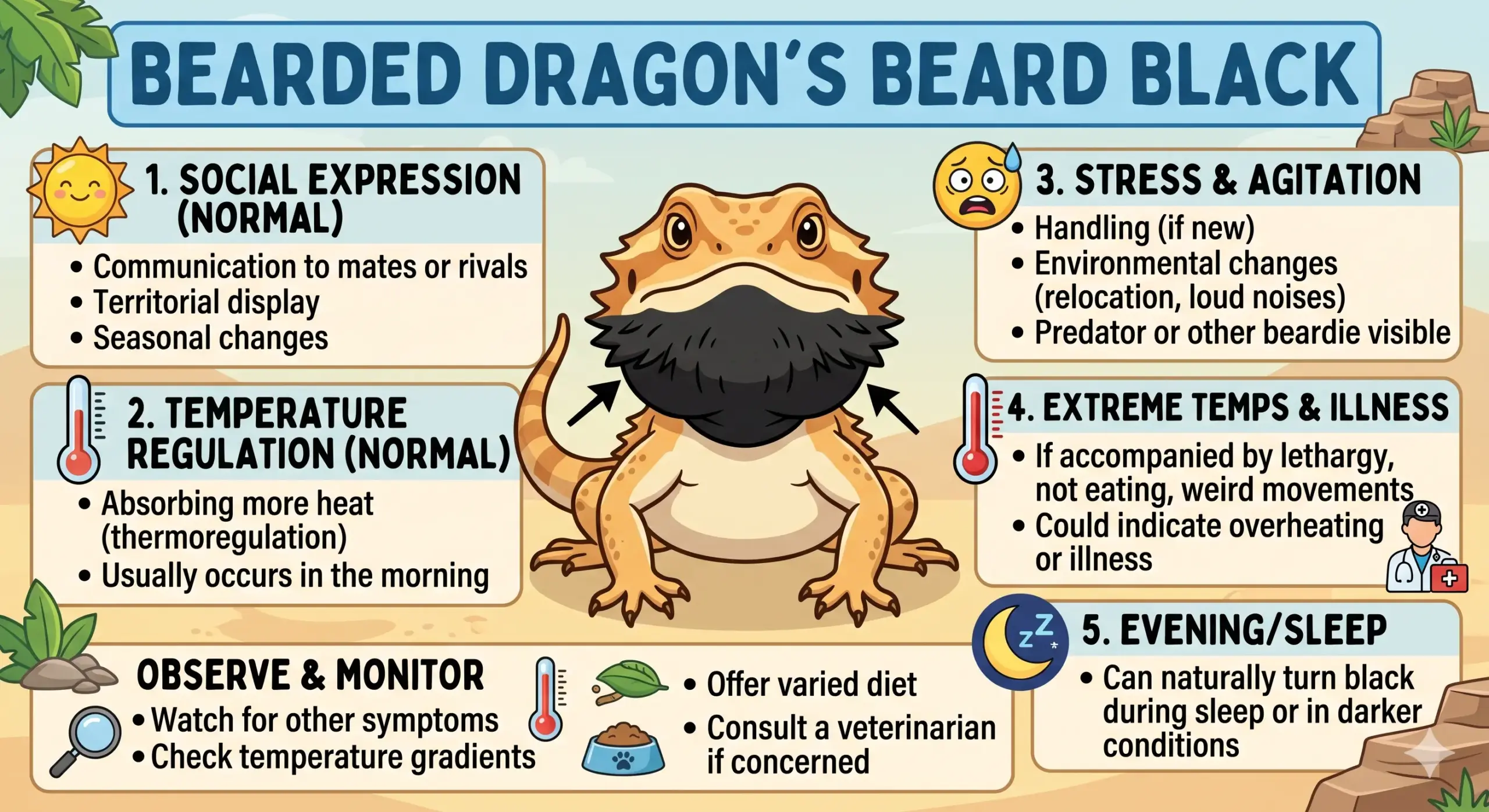
6. Bearded Dragon’s Beard Black Cues: Anger and Irritation Factors
Sometimes, your scaly companion simply isn’t in the proper mood for social interaction or handling. Just like humans, reptiles experience fluctuating moods and require periods of complete solitude to feel secure in their domestic environment without feeling constantly scrutinized by human eyes.
Recognizing these mood shifts is an essential component of becoming a responsible, empathetic reptile keeper. Forcing interaction when an animal triggers a protective cue will only damage the trust you have spent months carefully constructing through patient daily reinforcement.
Bearded Dragon’s Beard Black Visual Warnings: Setting Handling Boundaries
If you attempt to handle them while they are deeply asleep or in the middle of a meal, you might trigger a sudden behavioral reaction. This rapid response serves as an explicit boundary, politely requesting that you step away immediately from the habitat enclosure.
Bearded Dragon’s Beard Black Gestures: Body Language Signals Explained
This striking visual cue is a clear signal to back off and leave the enclosure alone for a few hours. Respecting these behavioral boundaries helps establish excellent long-term trust and mutual respect between you and your unique exotic pet over its lifetime.
7. Bearded Dragon’s Beard Black Events: Shedding Discomfort and Ecdysis
The natural process of shedding old skin, scientifically known as ecdysis, is an itchy, tight, and highly uncomfortable period for all reptiles. As their bodies grow, their old epidermal layer must loosen and detach completely to make room for new underlying scales.
During this uncomfortable transitional phase, your pet may become uncharacteristically grumpy, reclusive, or sensitive to tactile touch. Understanding the physical strain of ecdysis will help you provide the appropriate environmental assistance required to facilitate a clean break.
Bearded Dragon’s Beard Black Shapes: Skin Stretching Routines
If the old skin surrounding their neck and throat region is about to peel away, they will intentionally expand their tissue. This intentional stretching motion creates a temporary visual alteration as they work to break the stubborn old skin apart using mechanical friction.
Bearded Dragon’s Beard Black Forms: The Mechanical Process of Shedding
This mechanical stretching helps loosen the dead, dried-out epidermal layers so they can fall away naturally from the body. Seeing a darkened throat during an active shed cycle is usually nothing to worry about if the surrounding scales look dull or chalky.
Bearded Dragon’s Beard Black Phases: Bathing and Soaking Steps
While you must absolutely never pull peeling skin off with your fingers, you can offer gentle assistance to resolve a shedding-induced situation. Providing a shallow, lukewarm water bath for fifteen minutes works wonders to soften stubborn scales and soothe irritated reptile skin safely.
8. Bearded Dragon’s Beard Black Warning Signs: Identifying Serious Health Concerns
While temporary color shifts are a normal component of reptile life, a persistent dark throat is an entirely different matter. This is the most critical reason to actively monitor your pet’s daily appearance, as a long-term presentation is a major clinical red flag indicating potential systemic distress.
When an exotic animal experiences chronic internal pain, metabolic dysfunction, or infectious disease, it cannot voice its discomfort. Instead, its body maintains a state of constant stress, keeping the throat tissue darkened indefinitely as an internal distress signal that requires immediate intervention.
| Triggering Factor | Typical Duration | Accompanying Behaviors | Primary Recommended Action |
|---|---|---|---|
| Thermoregulation | 30 – 60 Minutes | Flattening body, morning basking | Verify basking zone temperatures |
| Environmental Stress | Temporary | Glass surfing, hiding away | Remove visible triggers or reflections |
| Natural Shedding | A Few Days | Rubbing against rocks, dull skin | Provide lukewarm shallow soaks |
| Systemic Illness | Chronic / Continuous | Lethargy, complete anorexia | Consult an exotic vet immediately |
Bearded Dragon’s Beard Black Crises: Clinical Illness Symptoms
If the darkened throat is accompanied by severe lethargy, a total lack of appetite, or prolonged hiding, it indicates serious internal distress. A healthy animal will clear its color once it warms up, but a sick pet experiencing a crisis cannot shed its dark tint easily.
Bearded Dragon’s Beard Black Patterns: Chronic Stress and Metabolic Bone Disease
Continuous environmental stress or inadequate UVB lighting set-ups can rapidly lead to debilitating conditions like Metabolic Bone Disease (MBD). If your reptile’s baseline color remains dark for days on end, its internal biological systems are actively struggling to survive under current parameters.
Bearded Dragon’s Beard Black Remedies: Seeking Professional Veterinary Guidance
If your presentation remains completely unchanged for several consecutive days without an obvious trigger, look for professional help. According to the informative guidelines published by the Association of Reptile and Amphibian Veterinarians (ARAV), chronic discoloration requires a professional veterinary exam.
9. Bearded Dragon’s Beard Black Solutions: Environmental Management Steps
If you have carefully analyzed the situation and successfully ruled out underlying medical conditions, you can implement home relaxation techniques. Minimizing external stimuli and optimizing habitat parameters will rapidly assist your stressed companion in returning to a calm, peaceful baseline state over time.
Remember that consistency and a calm demeanor are vital when interacting with an agitated reptile. Avoid making sudden overhead movements, keep ambient room noise to an absolute minimum, and allow the animal to dictate the pace of interaction without rushing their recovery window.
Bearded Dragon’s Beard Black Control: Thermal Parameter Adjustments
The absolute foundation of a happy, thriving reptile is a perfectly calibrated habitat that mimics their native arid wilderness. Incorrect environmental parameters are the hidden root cause of a significant percentage of chronic behavioral stress displays observed in domestic captivity today.
- The Primary Basking Spot: Ensure your localized basking zone temperature rests strictly between 38-42°C (100-108°F).
- The Ambient Cool Side: The opposite end of the enclosure must remain cooler, hovering safely between 24-28°C (75-82°F).
- Essential Tool Calibration: Always utilize high-quality digital thermometers with probes rather than unreliable, cheap plastic analog stickers.
Bearded Dragon’s Beard Black Management: Lighting and Visual Stimulation Controls
Overstimulation from overly bright ambient room lights, flashing television screens, or intense UVB bulbs can occasionally overwhelm a sensitive reptile. Briefly dimming the main lights in the room can provide an immediate sense of safety and resolve an acute episode caused by domestic chaos.
If your pet is continuously attacking its own reflection along the glass walls, apply non-reflective commercial tank backgrounds immediately. Covering the interior sides with simple construction paper stops them from endlessly fighting their own phantom reflection throughout the active daylight hours.
Bearded Dragon’s Beard Black Prevention: Proper Handling Approaches
If your exotic pet is normally docile and enjoys human touch, a very gentle, supportive cuddle against your warm chest might help them relax. However, you must always approach their body slowly from the side, rather than swooping down directly from above like a predator.
Swooping down from above mimics the natural hunting motion of a wild bird of prey, which instantly triggers a defensive posture within their primitive brains. If they remain extremely agitated, the absolute best thing you can do is simply walk away and leave them alone in their dark sanctuary.
Bearded Dragon’s Beard Black Suppression: Territory Enrichment Elements
A completely bare glass tank is a highly stressful environment that leaves a prey animal feeling naked and perpetually exposed to predators. Ensure your enclosure is filled with multiple dedicated cave hides, sturdy climbing branches, and ample artificial clutter like safe silk plants to boost safety indicators and lower the frequency of a reaction.
Giving your pet the ability to completely remove themselves from human sight lines dramatically reduces their daily cortisol levels. When a dragon knows it can hide safely at a moment’s notice, it becomes far less likely to display defensive behaviors when you walk into the room.
Conclusion: Decoding the Complex Language of Dragons
Accurately understanding your reptile’s unique body language is the ultimate secret to cultivating a happy, healthy, and long-lived pet. A dark throat is not a sign of a defective animal; it is simply their vibrant, non-verbal way of communicating their immediate structural needs directly to you. When looking closely at instances of a Bearded Dragon’s Beard Black reaction, remember that observation is your greatest ally.
By paying close attention to environmental context—whether it is simple morning thermoregulation or a protective reaction to a household pet—you can provide the exceptional care they deserve. Now that you know exactly why their throat turns dark, expand your reptile knowledge further by reading our specialized anatomical guide: Did You Know Your Bearded Dragon Has a Secret Third Eye?
Frequently Asked Questions About Black Beards
Q: How fast can a bearded dragon’s beard turn black?
A: It can happen incredibly fast! The color transition can take place within seconds if the animal experiences sudden fright, anger, or sees a perceived threat nearby.
Q: Do female bearded dragons get black beards too?
A: Yes, females can turn their throats black due to stress, shedding, or thermoregulation. However, they rarely display it as frequently or aggressively as adult males do during the mating season.
Q: Why does my bearded dragon have a black beard while sleeping?
A: If the tank temperature drops too low during the night, their body may darken to absorb whatever residual heat is left. Double-check your nighttime temperatures to ensure they aren’t freezing.
Q: Can relocation stress cause a constant black beard?
A: Absolutely. Moving to a new home or enclosure is highly stressful for them. It can take anywhere from a few days to two weeks for them to settle in and for their color to return to normal.