
Ever wondered what your bearded dragon sees when it stares blankly at the living room wall? It turns out that their world is a vibrant, ultra-sharp tapestry of colors, movements, and light spectrums completely invisible to human eyes.
A comprehensive bearded dragon vision simulator reveals that these reptiles see the world with incredible color accuracy, utilizing four distinct visual cones that allow them to process ultraviolet light alongside a specialized panoramic field of view.
By exploring this sensory world, keepers can understand how light placement, natural prey tracking, and environmental gradients directly shape daily reptilian behavior.
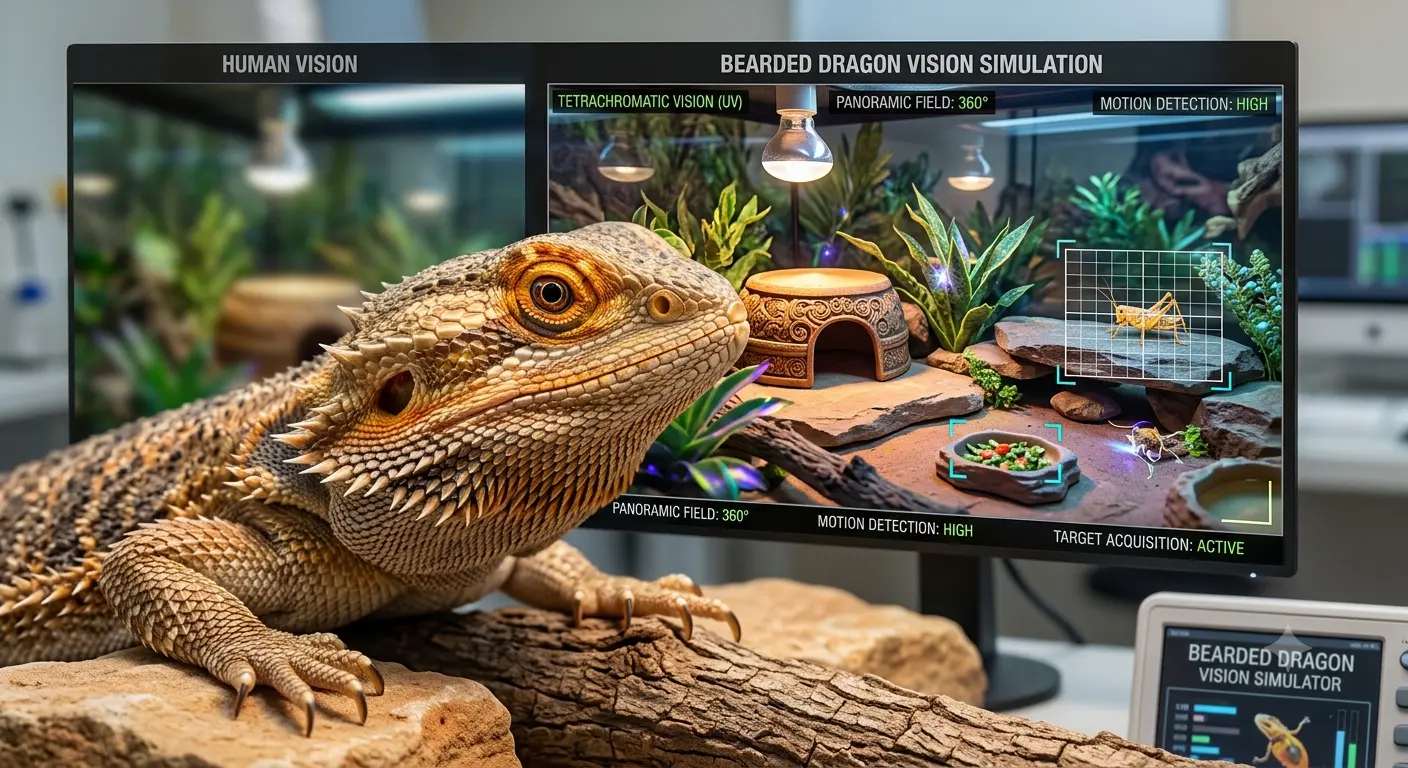
How the Bearded Dragon Vision Simulator Processes Color
To truly understand how these reptiles perceive their surroundings, we have to look closely at the biological structures within their eyes. Humans are trichromats, meaning our retinas contain three types of color-receptive cones: red, green, and blue.
Bearded dragons are tetrachromats, meaning they possess a fourth cone specifically tuned to perceive ultraviolet (UV) light waves. When programmed accurately, a digital simulation demonstrates a world where everyday objects possess deep, fluorescent highlights that humans cannot detect.
This fourth cone changes everything about their perception, turning an ordinary green leaf or a brown insect into a glowing, highly contrasting target. It helps them differentiate between nutritious vegetation and toxic plants in the wild.
Furthermore, their natural lenses filter out harmful light while amplifying ambient rays, ensuring that their color depth remains exceptionally sharp even under the blazing sun of their native habitats.
The Power of Tetrachromatic and UV Perception
The inclusion of ultraviolet perception means that your pet does not see a dull, desert landscape. Instead, the bearded dragon vision simulator shows how high-quality UVB bulbs illuminate an enclosure, making the entire environment pop with deep, complex visual textures.
Because they can see UV light, they also use it to recognize one another. Subtle variations in skin scales reflect UV wavelengths differently, signaling reproductive readiness, age, health status, and social hierarchy to other lizards nearby.
If you have ever noticed your lizard reacting intensely to a specific object, it might be reflecting UV rays in a way that startles or excites them. This extra visual dimension guides their social interactions and territorial displays.
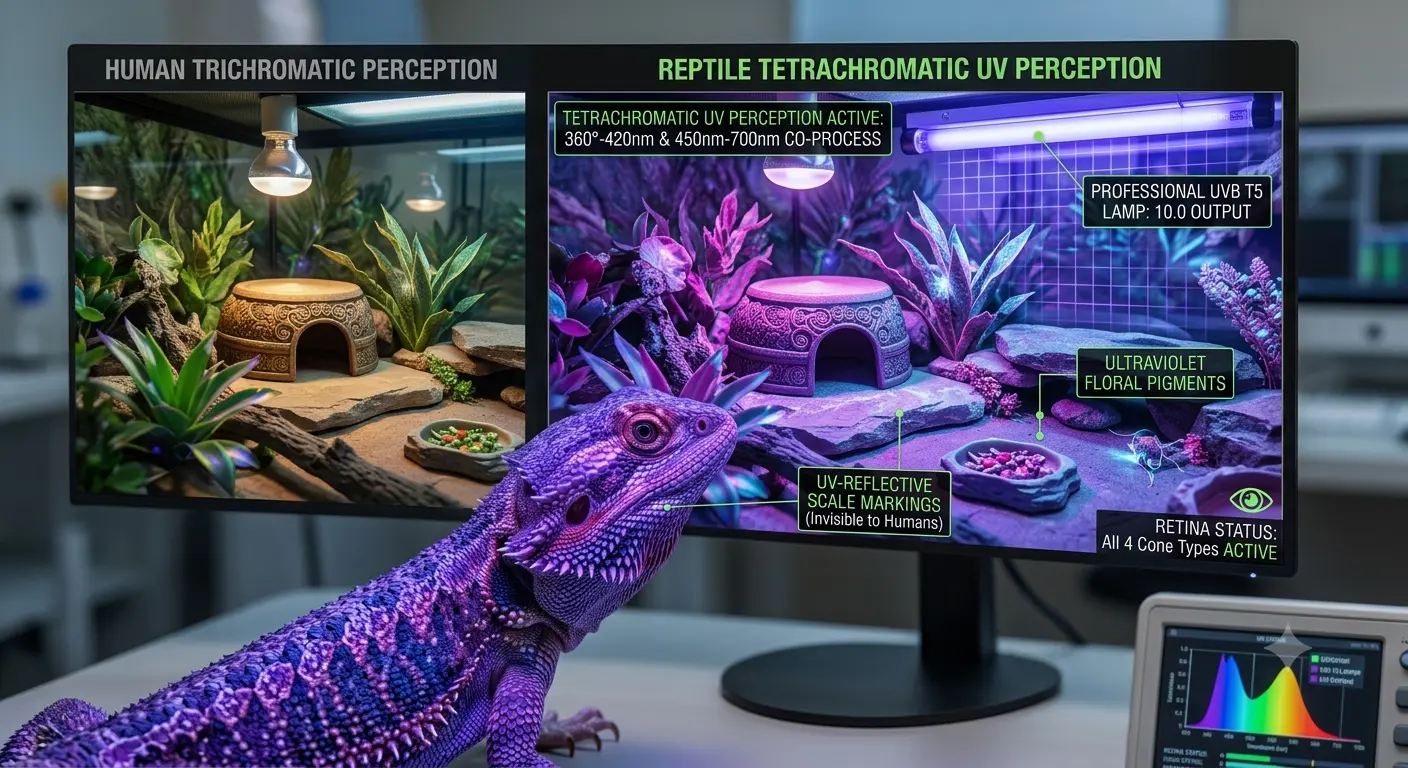
Depth Perception Challenges and Lateral Eye Placement
While humans have forward-facing eyes built for excellent binocular depth perception, reptiles have eyes located on the sides of their skulls. This lateral placement grants them an incredibly wide, almost panoramic view of their immediate surroundings.
This wide view lets them detect approaching predators from almost any angle without moving their heads. However, this safety feature comes with a biological trade-off: their front-facing depth perception is actually quite limited.
To accurately judge distances, they often rely on motion parallax, a technique where they bob their heads up and down or side to side. This movement allows them to calculate how far away a cricket or a climbing branch is.
When using a modern bearded dragon vision simulator, this perspective shift is clear. The wide lateral fields offer amazing motion detection, but the center overlay requires physical movement to lock onto static targets accurately.
Why Do Bearded Dragons Bob and Tilt Their Heads?
If you spend enough time observing your pet, you will notice frequent, deliberate tilts of the head when they look up at you or at an item inside their habitat. This behavior is directly tied to their specific macular anatomy.
Their eyes contain specialized areas of high visual acuity, but because these areas are fixed, the lizard must physically adjust its head angle to focus the clearest part of its lens directly onto an object of interest.
Tilting the head allows them to use their monocular vision to inspect strange objects safely from a distance. It provides a highly detailed image without forcing the lizard to turn its entire body toward a potential threat.
Head bobbing can also serve as a communication method, but when done slowly while staring at an object, it is simply a practical way for the lizard to map its physical environment and improve its focus.
My Journey with Jax: Learning to See Through Reptilian Eyes
A few winters ago, my male central bearded dragon, Jax, stopped eating entirely. He would sit in the far left corner of his wooden enclosure, staring blankly at his favorite climbing log with a dark, stressed beard. I panicked, thinking he had developed an internal infection or advanced metabolic bone disease.
I tried moving his food dish closer, switching from crickets to dubia roaches, and even hand-feeding him squash. Nothing worked, and my frustration grew as Jax kept ignoring everything around him while his weight dropped. I spent hours reading forums, wondering what crucial detail I was completely missing.
One evening, while cleaning the glass sliders, I accidentally bumped the heavy canopy fixture, shifting the specialized mercury vapor bulb three inches to the right. The next morning, Jax woke up, climbed straight to the top of his basking rock, and immediately hunted down every stray insect in his path.
That was the moment I realized the issue wasn’t the food at all; it was the light placement. By shifting the bulb, I had unintentionally removed a harsh, blinding glare reflecting off his glass wall, instantly opening up his field of view so he could actually see his food without being blinded by his own environment.
Anatomy of the Reptilian Eye vs. The Human Eye
Understanding the exact structural differences helps keepers design safer habitats. Reptiles possess unique physical features, such as a vascular structure called the conus papillaris, which supplies nutrients to the retina without casting shadows inside the eye.
Unlike humans, who possess a highly flexible lens that changes shape to focus, lizards use small ciliary muscles to physically push their rigid crystalline lens forward or backward, much like a manual camera lens adjusting its focus.
Additionally, they have voluntary control over their pupillary constriction. While human pupils dilate automatically based on light levels, a lizard can widen or narrow its pupils consciously based on focus, mood, or engagement.
This voluntary control allows them to maintain sharp focus on a moving insect even when transitioning between bright sunlight and dark, shadowed hiding spots in their enclosure.
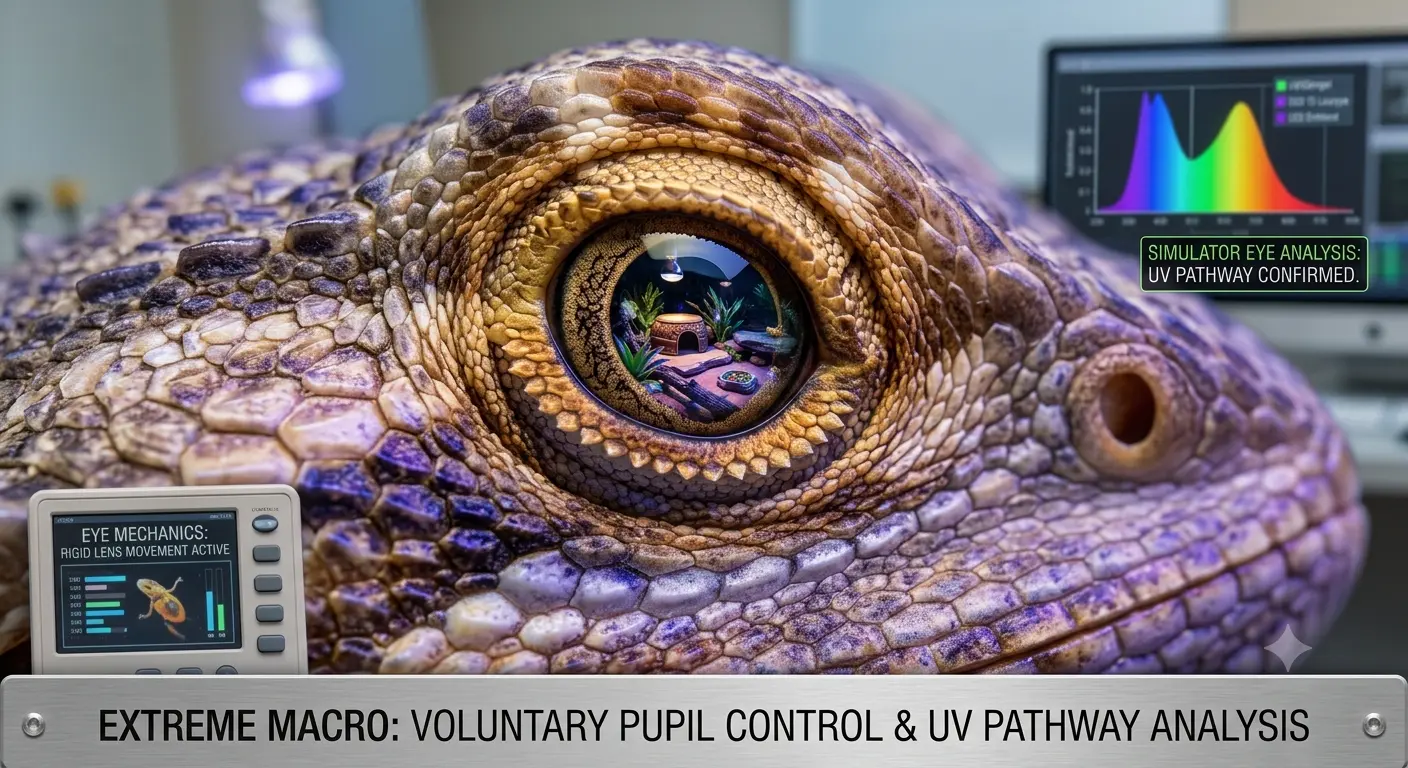
Comparing Human Vision and Bearded Dragon Sight
To help visualize these differences, this comparison matrix breaks down the unique visual traits that separate human sight from reptilian vision parameters:
| Visual Parameter | Human Sight Profile | Bearded Dragon Sight Profile |
|---|---|---|
| Color Cones | Trichromat (Red, Green, Blue) | Tetrachromat (Red, Green, Blue, UV) |
| Visual Field | ~180 Degrees (Forward Facing) | ~360 Degrees (Panoramic/Lateral) |
| Night Vision | Moderate (High Rod Density) | Poor (Pure Cone Retina, Needs Total Darkness) |
| Focus Mechanism | Flexible Lens Shape Accommodation | Rigid Lens Movement (Forward/Backward) |
| Depth Perception | Excellent (Overlapping Binocular) | Limited (Relies on Motion Parallax) |
The Critical Role of the Parietal “Third Eye”
You cannot fully understand a bearded dragon vision simulator without considering their unique parietal eye. Located on top of their head between their primary eyes, this small, translucent scale functions as a simplified light sensor.
While it cannot form clear images, it is highly sensitive to changes in light and shadow, protecting the lizard from predatory birds flying overhead. For more details on this fascinating organ, check out our guide on bearded dragon third eye secrets to see how it regulates daily behavior.
This sensor sends signals directly to the pineal gland, helping regulate thermoregulation, hormonal changes, and seasonal brumation cycles based on changing day lengths.
According to research by the Association of Reptile and Amphibian Veterinarians (ARAV), proper lighting cycles that respect these sensory organs prevent chronic stress and support overall immune health in captive reptiles.
Optimizing Enclosure Lighting Based on Visual Science
Knowing that your pet relies heavily on clear light cues means that choosing the right lighting elements is vital for their long-term health. Standard household LEDs often lack the necessary UV waves, which can cause their surroundings to look washed out or dull to them.
Always combine a high-output T5 UVB linear bulb with a bright, halogen basking lamp. This combination mimics the natural spectrum of the sun, keeping your lizard active, alert, and eager to eat.
Avoid using colored night lights, such as blue, red, or purple bulbs. Because their retinas are packed with highly sensitive cones, they can see this colored light clearly, which disrupts their sleep patterns and leads to long-term stress.
At night, turn off all light sources completely. Their eyes need total darkness to rest properly, allowing their bodies to cool down and recover naturally until the next morning cycle begins.

How Movement and Motion Drive Reptilian Instincts
Have you ever noticed your lizard ignore a piece of fresh greens until a breeze or your fingers move it slightly? Their visual processing systems are fine-tuned to prioritize motion over static shapes.
In the wild, a stationary insect is hard to spot against rocks and dirt, but the slightest twitch triggers an immediate predatory response. This focus on motion keeps them safe from predators and helps them hunt efficiently.
If your pet is a picky eater, try dusting their greens with a light supplement and gently wiggling them with feeding tongs. Triggering their motion detection can spark their natural hunting drive and encourage them to eat.
Understanding this trait helps you create a more engaging environment, keeping your pet active, healthy, and responsive to their surroundings.
Summary of Key Visual Insights
Using a bearded dragon vision simulator reminds us that these amazing reptiles experience their world in a unique way. By matching our husbandry practices to their visual biology, we can ensure they stay healthy and stress-free in our homes.
Make sure to provide high-quality lighting, avoid sleep-disrupting night lights, and design their habitat to fit their panoramic vision. Giving your pet a comfortable environment supports their natural instincts and long-term well-being.
Frequently Asked Questions About Reptilian Vision
Can bearded dragons see in total darkness?
No, they cannot see well in the dark. Their retinas consist almost entirely of cone cells designed for bright daylight, meaning they lack the rod cells needed for night vision. They require complete darkness at night to sleep soundly.
Why does my lizard close one eye when looking at me?
This is often a sign of focus or mild stress. By closing the eye facing you, they are shutting out a potential threat or focusing their attention elsewhere using their opposite, lateral eye to monitor the rest of the room.
Do colored lights hurt their eyes?
Yes, colored night bulbs can disrupt their sleep and cause long-term stress. Because they see colors vividly, red or blue bulbs prevent them from resting properly. It is always best to use ceramic heat emitters if you need extra warmth at night.
How far can a bearded dragon see clearly?
They have excellent long-distance vision and can spot movements or flying birds from dozens of yards away. However, their close-up vision is much weaker, which is why they sometimes miss crickets sitting right in front of them.