
The Shift from Caging to Habitat Engineering
Most hedgehog owners buy an enclosure. The ones whose animals genuinely thrive build an environment — and that distinction is everything.
A cage keeps an animal alive. A well-engineered habitat allows it to function as biology intended.
The concept of habitat engineering reframes the enclosure as a closed-loop life-support system — one where temperature, humidity, light cycles, substrate depth, and spatial complexity work together rather than in isolation.
This isn’t a luxury upgrade. Research cited by the Journal of Veterinary Behavior suggests that 75% of captive exotic animals do not have their core environmental needs met.
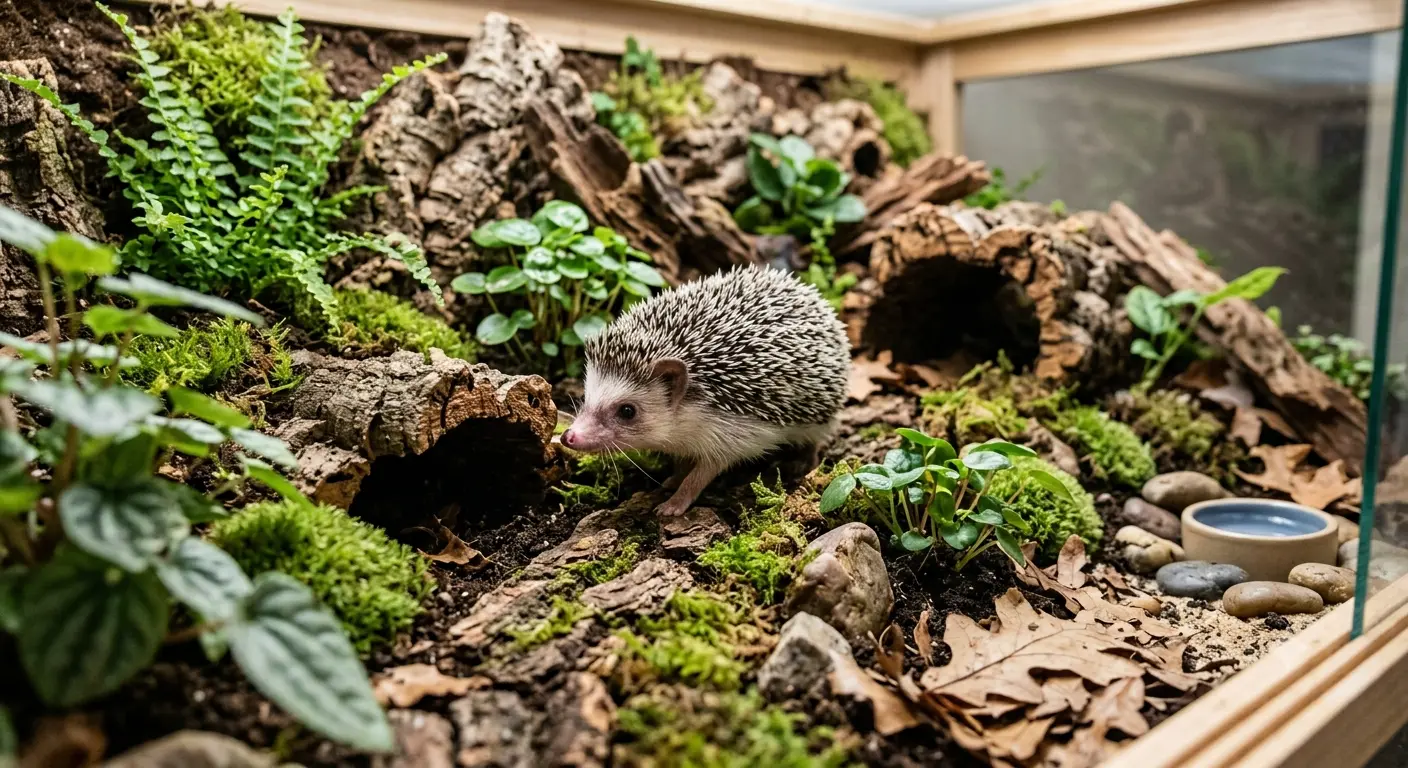
This failure results in chronic physiological stress that shortens lifespans and degrades quality of life. That failure isn’t usually cruelty — it’s a design problem.
The framework borrowed from conservation science is biomimicry: using the wild habitat as the engineering blueprint.
For African Pygmy Hedgehogs, that means replicating the semi-arid savannas of East Africa, not just providing floor space.
When you understand what a hedgehog’s environment actually demands, you stop asking “is my hedgehog surviving?” and start asking “is every system in this enclosure supporting biological optimization?”
The gap between those two questions starts with temperature — arguably the single most consequential variable in the entire setup.
Thermal Stability and the Metabolic Engine
Temperature is the single most controllable variable in effective environmental and habitat engineering for African Pygmy hedgehogs — and the one most owners get dangerously wrong.
African Pygmy hedgehogs originate from semi-arid regions of East Africa, which means their bodies are calibrated to a narrow thermal band.
Experts recommend a consistent ambient temperature of 72°F to 80°F — a window so specific that even modest drops can trigger a physiological shutdown response.
Unlike true hibernators, domesticated African Pygmy hedgehogs lack the metabolic machinery to survive torpor safely. What looks like peaceful sleep can be the beginning of organ failure.
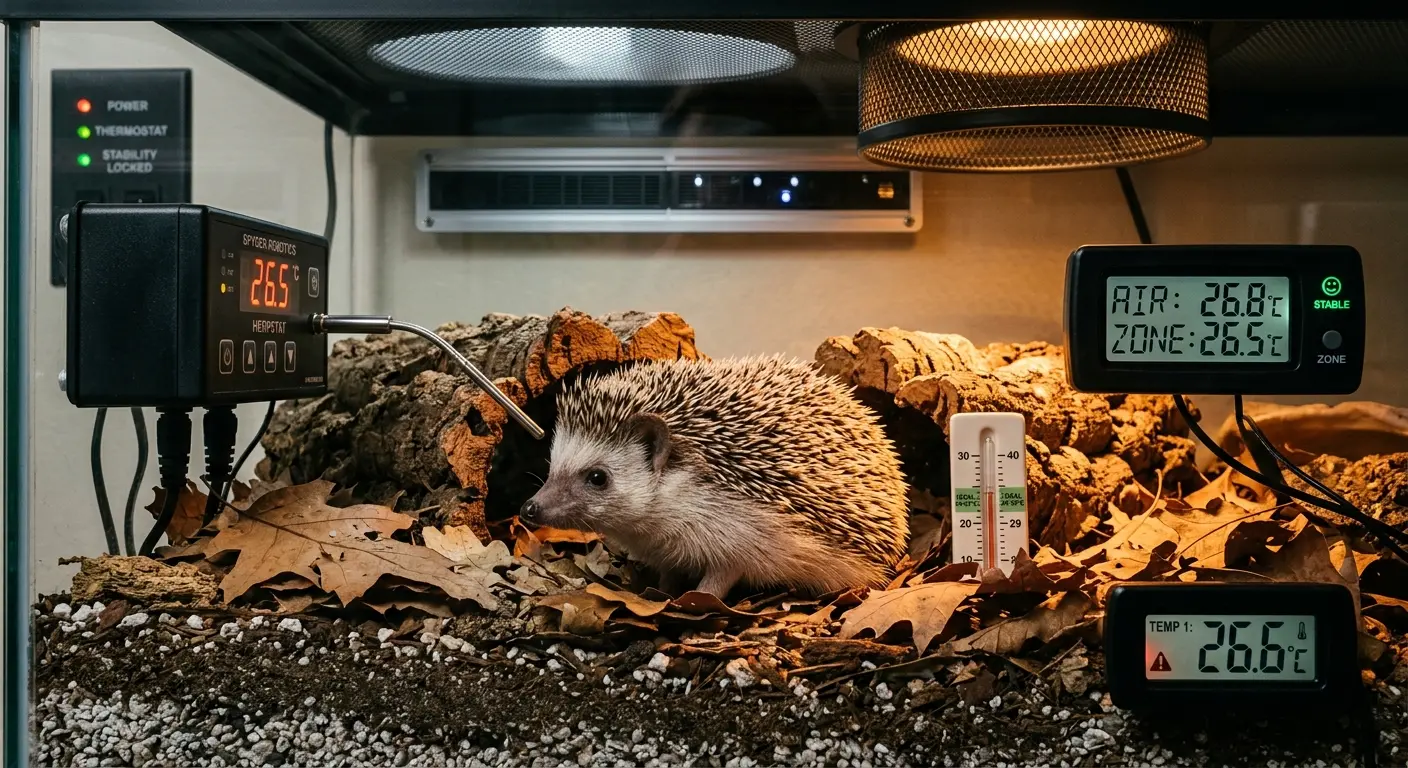
The solution isn’t simply “keep it warm.” It’s building a thermal gradient — a warm zone and a cooler retreat — so the animal can actively regulate its own body temperature by moving between them.
Research cited by the Merck Veterinary Manual notes that access to a proper thermal gradient can improve digestive efficiency by up to 40%, because metabolic rate responds directly to ambient temperature.
Hardware matters here. The physics of heat delivery are not interchangeable:
- Ceramic heat emitters (CHEs): Radiate ambient warmth without emitting light, making them ideal for 24-hour use and overhead mounting to warm the air column.
- Radiant heat panels: Gentle, consistent, and less likely to create hot-spot burns than traditional bulbs.
- Under-tank heat mats: Produce surface contact heat rather than air temperature — useful as a secondary source but inadequate as a sole heating method.
Thermostats are non-negotiable — and redundancy saves lives. A single thermostat failure on a cold night is a medical emergency.
In practice, a primary thermostat paired with a backup unit and a digital thermometer with an alert function represents the minimum responsible setup.
Getting temperature architecture right is foundational, but it’s only one layer of the habitat. The substrate beneath your hedgehog’s feet is equally engineered — and that’s where microbial biology enters the picture.
Bioactive Systems and Microbial Waste Management
A thoughtful hedgehog habitat setup doesn’t just manage waste — it eliminates the conditions that allow harmful waste byproducts to accumulate in the first place.
The substrate layer is where habitat engineering either succeeds or fails. Most owners treat the floor of an enclosure as a surface to clean.
A bioactive approach treats it as a living system — one populated with microscopic and small-bodied organisms that actively process organic matter before it becomes a problem.
Isopods and springtails are the foundation of that system. Isopods consume decaying organic matter and waste solids, while springtails break down fungal growth and fine particulate debris.
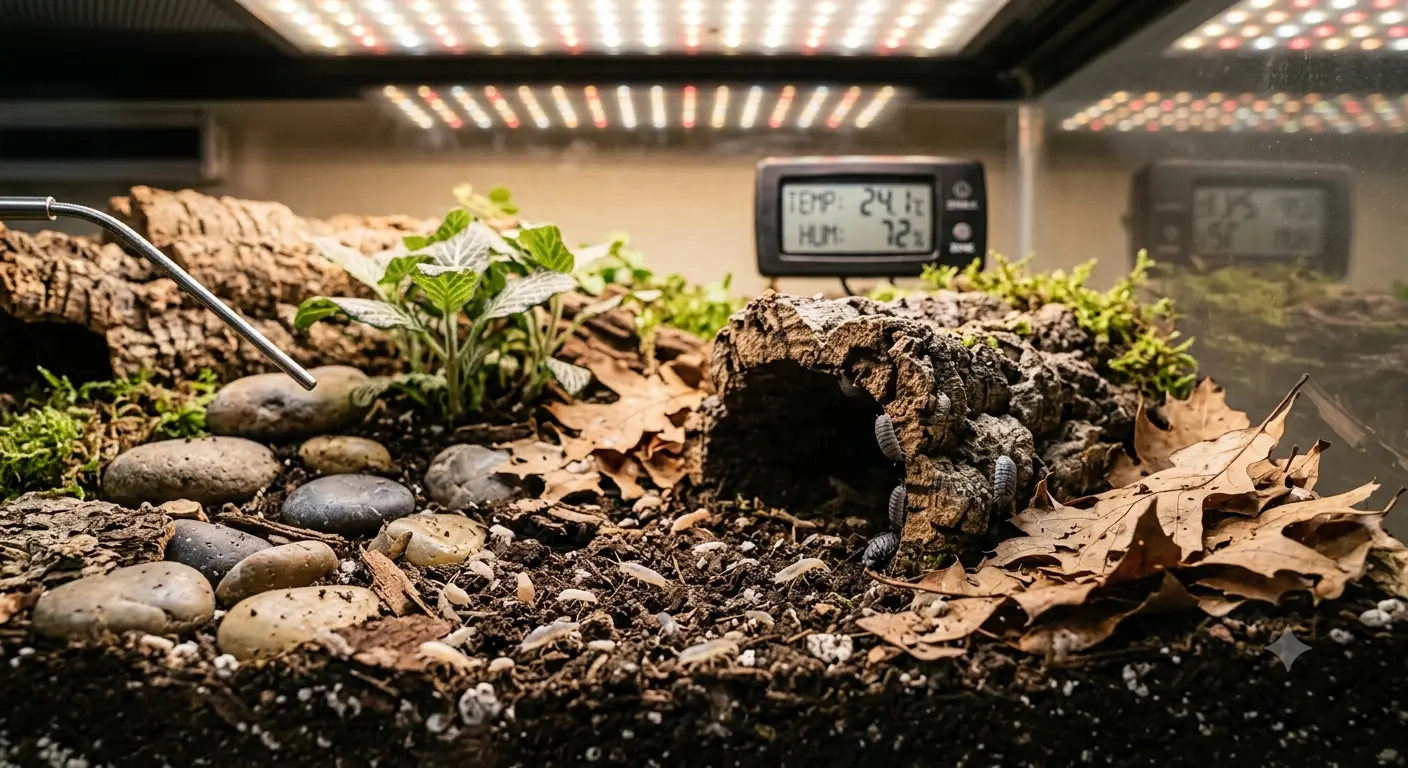
Together, they drive a localized nitrogen cycle: organic nitrogen from waste is converted into less harmful compounds, then further processed by microbial communities in the substrate.
According to The Bio Dude, bioactive substrates containing live micro-fauna measurably reduce ammonia buildup — the primary airborne irritant responsible for hedgehog respiratory stress.
This matters beyond convenience. Persistent low-level ammonia exposure compromises mucosal membranes and suppresses immune response over time.
This is a slow risk that standard spot-cleaning doesn’t fully address. Mimicking the natural nitrogen cycle at the substrate level creates a self-regulating buffer against that exposure.
For owners interested in caring for hedgehogs long-term, this microbial foundation supports the same biological stability their wild counterparts rely on daily.
Once the substrate is working as a system, the enclosure’s upper layers — texture, climbing structures, foraging zones — take on a new role entirely.
Environmental Enrichment as a Biological Necessity
Cognitive stimulation isn’t optional in hedgehog habitat design — it’s a structural requirement with measurable consequences for immune function and neurological health.
As Dr. Clifford Warwick, PhD, CBiol, FRSB, states plainly: “Environmental enrichment is not a luxury; it is a biological necessity that directly impacts the neurological health and immune function of captive exotic animals.”
An empty enclosure isn’t minimalist design — it’s an engineering failure.
Just as meeting hedgehog temperature requirements protects the metabolic engine, meeting cognitive requirements protects the neurological one. Both systems are interdependent.
The physical needs of hedgehogs in captivity extend well beyond food, warmth, and a wheel — the enclosure layout itself must actively stimulate foraging behavior.
| Enrichment Type | Biological Function | Engineering Implementation |
|---|---|---|
| Foraging opportunities | Reduces cortisol; supports immune regulation | Scatter feeding, hidden food stations |
| Varied textures | Stimulates sensory neurons; builds neuroplasticity | Cork bark, fleece, moss, smooth stone zones |
| Climbing structures | Promotes muscle engagement and proprioception | Low ramps, cork rounds, textured hides |
| Exploration corridors | Prevents stereotypic behavior; supports mental health | Tunnels, rotating hide placement |
In practice, wild African Pygmy hedgehogs travel several miles nightly across varied terrain, encountering constant novel stimuli.
A captive layout that replicates this complexity — even imperfectly — meaningfully reduces stress-related illness.
The engineering investment required to build this kind of enclosure has real long-term implications for care costs, which the next section addresses directly.
The Economic Reality of Engineering a Habitat
A professionally engineered hedgehog habitat costs more upfront — but the alternative is paying that difference in emergency veterinary bills.
The cheapest setup is almost always the most expensive one over time. A basic enclosure with no thermostat, inadequate lighting, and paper bedding might run $50–$80.
A properly engineered habitat with a quality thermostat, UVB/UVA lighting, and a bioactive substrate system typically runs $200–$400. That gap feels significant until the first crisis hits.
Upfront Costs Worth Taking Seriously
The non-negotiable investments are thermal control and lighting. A reliable thermostat — the kind that maintains consistent ambient temperatures and triggers alerts when temps drop — runs $30–$80 alone.
Paired with proper ceramic heat emitters and a lighting timer, you’re building redundancy against hedgehog hibernation risk, which can turn fatal within hours of temperature collapse. These aren’t accessories; they’re life-support infrastructure.
Long-Term ROI: Engineering vs. Emergency Care
A single exotic vet visit for torpor, respiratory illness, or stress-related disease easily runs $150–$400.
Over a hedgehog’s five-year lifespan, according to Exopetsecrets Research, budgeting for specialized veterinary care is essential.
However, engineering a habitat that prevents illness in the first place is the smarter financial strategy. A $300 setup that delivers five healthy years consistently outperforms a $75 setup that generates recurring crises. The math isn’t complicated; the commitment is.
Understanding these cost dynamics sets the stage for distilling everything into the core principles that make habitat engineering work.
The Bottom Line: 5 Pillars of Habitat Engineering
A well-designed hedgehog enclosure rests on five non-negotiable pillars — and understanding each one separates a survival setup from a thriving ecosystem.
Thermal gradients are the foundation. Hedgehogs have a dangerously narrow thermal window, and failure to maintain it triggers life-threatening torpor — a state that stresses organs and can turn fatal without rapid intervention.
This isn’t a comfort preference; it’s a metabolic requirement with zero flexibility.
Redundancy in heating systems is the safety net. A single heat source that fails overnight is an emergency.
Experienced keepers build backup systems into their design from day one, treating heating redundancy the same way pilots treat instrument checks — non-negotiable protocol, not optional caution.
Bioactive substrate outperforms paper bedding on every biological metric. A properly layered bioactive substrate supports microbial waste management, maintains ambient humidity, and engages natural foraging behaviors simultaneously. It’s a living system working in the background, not a passive liner.
Enrichment is structural, not decorative. As covered in earlier sections, cognitive stimulation directly influences immune resilience. Tunnels, foraging stations, and sensory variation belong in the blueprint, not the afterthought category.
A habitat is a dynamic ecosystem, not a static box. Zones shift, substrates evolve, and enrichment rotates — just as a wild hedgehog’s natural range and terrain changes with seasons.
Keepers who understand this truth stop maintaining a cage and start managing a living environment. That mindset shift — from static container to engineered ecosystem — is exactly what the next level of husbandry builds on.
Advancing Your Husbandry with Science-Backed Guides
The gap between keeping a hedgehog alive and helping one genuinely thrive comes down to one thing: the quality of information guiding your decisions.
Species-specific care manuals matter precisely because hedgehogs are not generic small mammals. Their thermoregulatory biology, nocturnal rhythms, and stress responses demand targeted guidance — not advice borrowed from rabbit or hamster husbandry.
A keeper who understands why handling matters and how enclosure temperature directly influences behavior is operating at a fundamentally different level than one improvising from general pet store advice.
Transitioning from beginner to advanced keeper is less about years of experience and more about intentional learning. In practice, advanced husbandry means reading the animal — recognizing when lethargy signals a thermal problem versus illness, or when substrate choice is affecting respiratory health.
That progression only happens when care frameworks are grounded in biology, not assumption. For those seeking comprehensive guidance, using a wild hedgehog guide provides critical baseline insights into replicating natural behavioral cycles and environmental requirements accurately.
As one engineering and biomimicry perspective puts it, “intelligence did not start with us… we must also design with humility” — a principle that applies just as cleanly to building hedgehog habitats as to designing cities.
Exopetsecrets exists to bridge that gap — translating complex exotic animal biology into clear, actionable care steps that any keeper can implement.
Whether you’re evaluating enclosure dimensions or understanding what makes hedgehogs rewarding to keep, the goal is always the same: science-backed decisions that serve the animal.
Ready to go deeper? Explore the 5 Proven Pillars of Exotic Pet Health at Exopetsecrets and build a care strategy your hedgehog’s biology actually supports.