
If you have ever had the unique pleasure of watching a hedgehog move across a room, you will instantly notice how their tiny, button-like nose is always in motion. Their ears constantly twitch, capturing frequencies that humans completely miss. There is a deeply fascinating biological reality behind these hyper-active sensory adjustments: most domesticated and wild hedgehogs live in a blurred reality, being practically a hedgehog blind creature that relies on alternative mechanisms to map their surroundings. While they possess structural eyes, their capacity to perceive shapes, depth, and sharp colors is fundamentally limited, leaving them to interpret a magnificent world built entirely out of intense scent trails, subtle acoustic vibrations, and tactical environmental feedback.
Understanding how a hedgehog blind creature navigates its daily routine is crucial for any exotic pet owner or wildlife enthusiast. These creatures do not look at the world; they feel it, smell it, and hear it with breathtaking precision. When we look at their behavior from a human perspective, we often misunderstand their reactions, misinterpreting their hesitation or defensive posturing as simple shyness. In truth, they are constantly processing an overwhelming influx of sensory data through specialized internal systems. In this comprehensive, deep-dive architectural breakdown, we reveal 7 shocking facts about hedgehogs that prove they are much more than just cute, prickly balls, shedding a bright light on their evolutionary marvels.

1. The Invisible World: Navigating as a Hedgehog Blind Specimen
Because hedgehogs are strictly nocturnal creatures that evolved to hunt during the darkest hours of the night, their visual reliance has degraded significantly over millennia. Evolution has essentially prioritized other survival mechanics over optical acuity, leaving the modern hedgehog blind to the finer details of our physical environment. They cannot judge distances effectively, meaning a drop from a high couch looks exactly the same to them as a flat floor. This lack of depth perception makes them vulnerable to accidental falls in domestic households, necessitating careful physical management by their human caretakers.
To fully compensate for this evolutionary trade-off, nature has gifted these small mammals with a literal “super-nose” and incredibly responsive “super-ears.” A healthy hedgehog blind pet can easily detect the faint, rhythmic scraping of tiny insects moving deep underground through structural soil layers, and they can catch the olfactory signature of a tiny piece of food from multiple blocks away. When they move across an open field or your living room carpet, they are not looking where they go in a traditional sense. Instead, they are tracking a complex, invisible map made of local humidity variations, left-behind scent markers, and low-frequency floor vibrations.
How the Hedgehog Blind Navigation System Works
The neurological processing of a hedgehog blind specimen is heavily focused on the olfactory bulb and the auditory cortex of the brain. When light hits their retinas, it registers mostly as a simple binary shift between light and darkness, which helps them recognize when it is time to wake up or hide from diurnal predators. However, for actual spatial movement, their whiskers act as high-precision proximity sensors. These tactile hairs measure tight spaces and structural boundaries, ensuring the animal can squeeze into safe cavities without getting stuck or damaging its sensitive skin tissue.
2. The Bizarre “Self-Anointing” Spit Bath
This is perhaps the most shockingly bizarre behavior you will ever witness when observing these unique mammals in captivity or in the wild. When a hedgehog encounters a completely unfamiliar scent marker—such as your expensive new perfume, a fresh garden plant, or unique leather shoes—it will not simply sniff it and move on. Instead, they begin to chew intensely on the object or the immediate area, generating a thick, frothy, white foam directly inside their mouths through rapid salivation. It is a striking sight that often alarms new owners who mistake it for a medical emergency.
Once the mouth is completely filled with this white froth, the hedgehog will contort its entire spine into seemingly impossible positions, using its long tongue to smear that thick spit all over its sharp quills. While it honestly looks like a dramatic scene pulled straight from a classic horror movie, this behavior is a brilliant biological process. It is how they chemically “bookmark” new environmental smells, camouflage their own natural musk from apex predators, and potentially create a toxic shield on their spikes by mixing external elements with their own complex saliva properties.
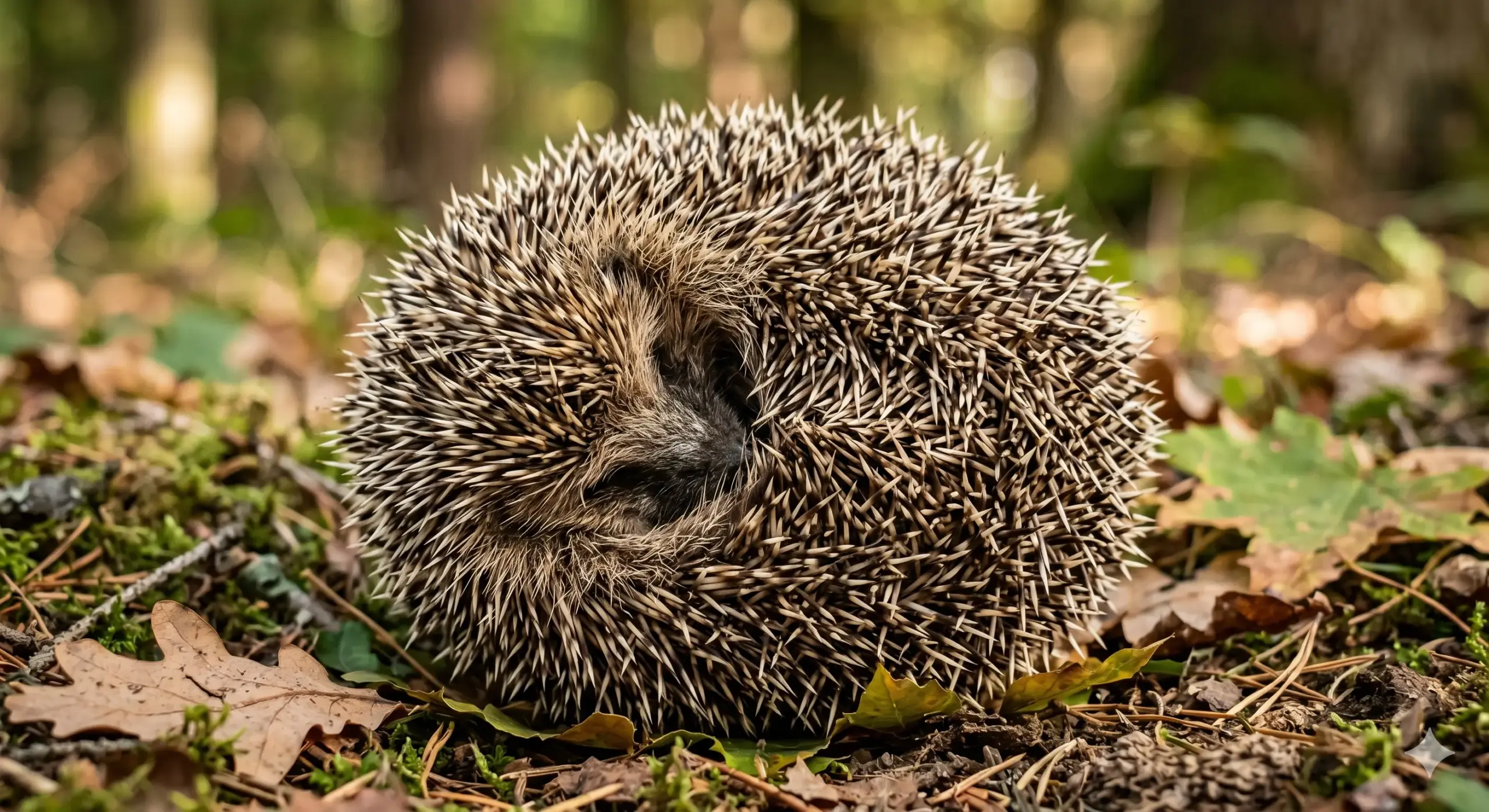
3. Built-In Body Armor: 5,000+ Shock-Absorbing Spikes
A hedgehog’s back is an engineering masterpiece covered in approximately 5,000 to 7,000 individual quills, known formally as spines. These highly modified hairs are not just sharp weapons meant for simple visual show or basic intimidation. Each individual quill is entirely hollow inside, reinforced with a complex network of internal air chambers that provide incredible structural integrity while remaining exceptionally lightweight. This prevents the heavy weight of the armor from crushing the animal’s delicate internal muscular framework over extended periods.
Furthermore, these unique quills function precisely like mechanical shock absorbers. If a wild or domestic hedgehog blind to a drop accidentally slips from a steep, high ledge, its immediate defensive reflex is to curl tightly into a solid ball. As it strikes the ground, it literally “bounces” off the hard impact surface. The flexible bases of the thousands of spikes bend uniformly, safely absorbing the kinetic energy of the fall and effectively distributing the force across the entire body mass, which prevents severe internal organ damage or broken skeletal structures.
4. Snake Venom? No Problem At All!
One of the most genuinely “badass” biological facts about the hedgehog lineage is their natural, built-in evolutionary immunity to lethal snake venom. They possess a highly specialized, modified protein structure within their blood plasma that actively neutralizes the destructive toxins of dangerously venomous snakes, such as European adders. This means a dose of venom that would easily paralyze or kill a much larger mammal has very little physiological effect on a standard hedgehog, allowing them to occupy unique predatory niches.
In a raw structural fight between a venomous snake and a wild hedgehog, the prickly mammal often emerges as the definitive victor. They utilize a brilliant tactical strategy: they curl into a tight protective ball, exposing nothing but an impenetrable wall of sharp, interlocking needles. The snake repeatedly strikes out of frustration, injuring its own sensitive mouth on the sharp quills. Once the snake is exhausted, bleeding, and weakened by its own self-inflicted wounds, the hedgehog uncurls and delivers a fatal bite to the spine, promptly eating the snake as a high-protein meal.
5. The Human Experience: Life with a Blind Companion
I remember the first night I brought my hedgehog home. The room was silent. I sat on the cold floor, watching this tiny, fragile ball of needles tucked into the corner of the enclosure. He wouldn’t move. Every time I breathed too loudly, he would click and hiss, a sharp defense mechanism against an invisible threat. It was a humbling moment that made me realize how terrifying it must be to navigate a world you cannot see. My hands felt giant, clumsy, and dangerous to a creature that views the universe through smells and shadows.
Days turned into slow weeks of quiet patience. I started leaving an old, unwashed cotton t-shirt inside his cage so he could memorize my specific scent profile without fear. Trust didn’t happen overnight; it was built in millimeters. One quiet evening, he finally stopped huffing when I lifted him up. His soft, unprotected belly uncurled completely in my warm palm, and his wet nose began to twitch against my thumb. It was a beautiful, silent breakthrough. He knew me. In that soft moment, his complete lack of vision didn’t matter anymore because we had found a way to speak the same silent language of trust.
6. The Deadly Milk Myth: A Threat to Hedgehog Health
For generations, well-meaning gardeners and wildlife lovers have left out a traditional shallow bowl of cow’s milk for wild hedgehogs visiting their backyards. While this gesture comes from a place of genuine kindness, it is a devastatingly deadly mistake for the animal’s delicate internal anatomy. Hedgehogs are strictly and severely lactose intolerant from the moment they are fully weaned from their mothers. Their digestive tracts lack the essential lactase enzymes required to break down and process the complex sugars found naturally in dairy products.
Drinking standard cow’s milk induces severe, agonizing digestive distress, acute intestinal inflammation, and explosive diarrhea. Because a hedgehog blind to the dangers of dehydration cannot easily find alternative fluids in time, this gastrointestinal purging quickly drains their small bodies of essential moisture, leading directly to fatal organ failure. To support these creatures safely, you must completely avoid dairy. Always stick exclusively to offering clean, fresh water in a heavy shallow dish alongside a portion of premium, high-quality meat-based cat food.
| Dietary Item | Safety Status for a Hedgehog Blind Pet | Physiological Impact on Hedgehogs |
|---|---|---|
| Fresh Clean Water | Highly Safe | Maintains optimal systemic hydration and supports healthy kidney function. |
| High-Quality Cat Food | Highly Safe | Provides essential proteins and necessary nutrients for muscular maintenance. |
| Cow’s Milk & Dairy | Extremely Deadly | Causes severe lactose intolerance, acute diarrhea, and fatal dehydration. |
| Commercial Insect Mix | Safe Accent | Mimics natural wild foraging diets and stimulates mental engagement. |
7. They Are Unexpected Olympic Runners
Do not let those short, stubby legs and somewhat clumsy, waddling gait fool you into thinking these animals are lazy or slow. In a single active night, a healthy, energized hedgehog blind explorer can run up to 2 miles (more than 3 kilometers) exploring territory! Their metabolic drives require immense physical exertion to burning off caloric intake. They are incredibly active nocturnal explorers that need a massive amount of physical space to roam freely, which is why a large, solid-surface running wheel is an absolute “must-have” requirement for any domestic pet hedgehog enclosure.
8. “Brumation” vs. True Hibernation
If a domesticated pet hedgehog is exposed to a sudden drop in ambient temperature, its primal genetic instincts will trigger, and its body will attempt to enter a state of forced hibernation, often referred to as brumation. However, for African Pygmy hedgehogs kept as household pets, this state is exceptionally dangerous and rapidly becomes fatal. Unlike their wild European cousins, domestic pet species do not possess the dense brown fat reserves or the specialized metabolic adaptations required to survive prolonged periods of dropped body temperatures.
When a domestic hedgehog blind to its own physiological limitations falls into this cold torpor, its heart rate drops to dangerously low levels, and its immune system completely shuts down. Exotic pet owners must remain incredibly vigilant, keeping the pet’s immediate living environment at a strictly regulated, constant temperature between 72°F and 80°F (22°C to 26°C) all year round. Utilizing dedicated ceramic heat emitters connected to digital thermostats is the most reliable way to prevent these life-threatening hibernation attempts from ever occurring.