
1. Defensive Hedgehog Body Language: The “Ball” and Quilling
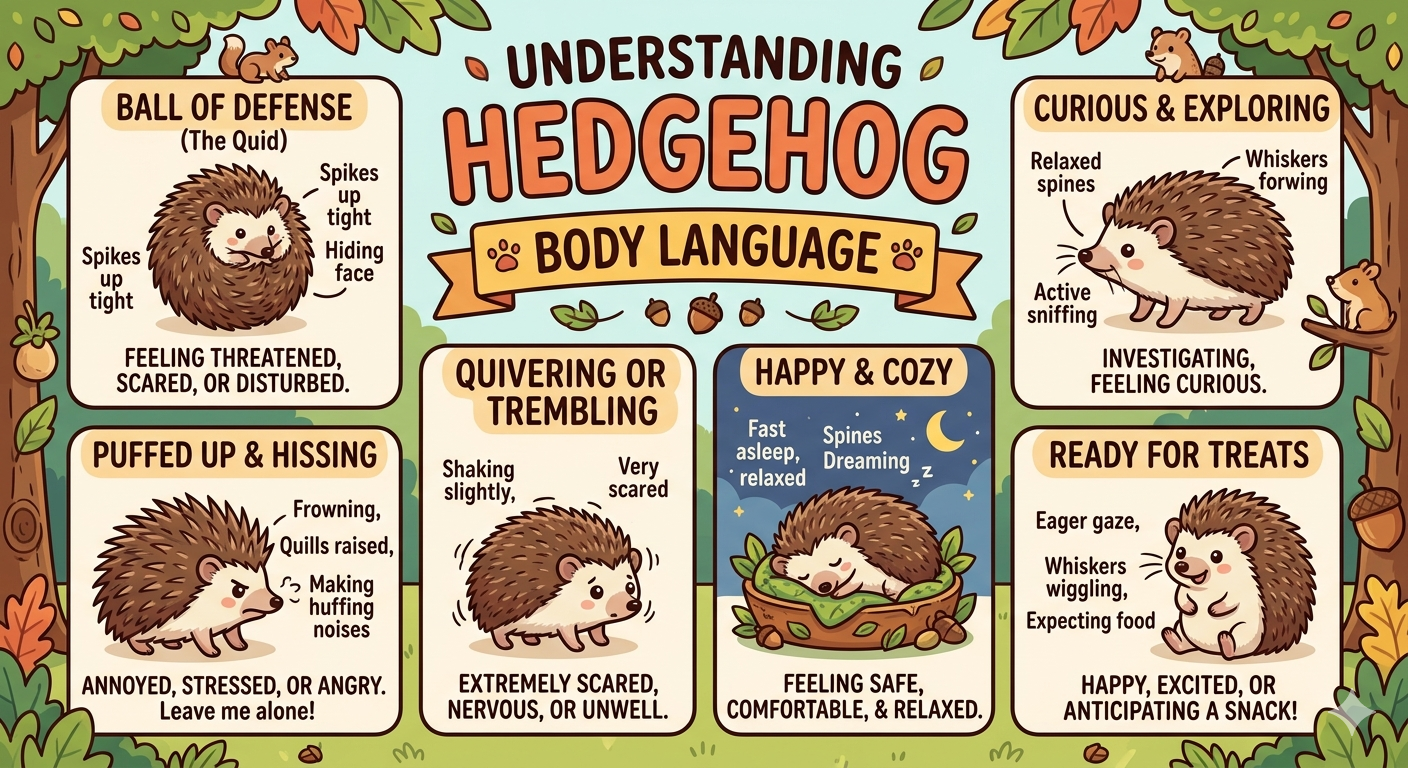
The most iconic aspect of Hedgehog Body Language is their ability to curl into a tight, spiny ball. This is a natural, evolutionary defense mechanism designed to protect their vulnerable underbelly from predators. When a hedgehog feels threatened by a loud noise, a sudden movement, or an unfamiliar scent, it uses powerful orbicularis muscles to pull its head, limbs, and tail entirely inside, leaving only a geometric sphere of sharp quills exposed to the outside world.

If your pet stays in a tight ball for a long time, it simply means they don’t feel safe yet. Patience is key here; forcing a hedgehog open can break their trust permanently. Another crucial defensive sign within Hedgehog Body Language is “clicking” or “popping” while fully curled. This rhythmic twitching is a physical warning that they are highly escalated and ready to strike or jump outward if you get too close. Erect quills that point in crisscrossed directions indicate high alertness and stress, whereas relaxed quills lie completely flat and smooth against the body.
2. Understanding Hedgehog Sounds and Vocals
Hedgehogs are surprisingly vocal creatures. By matching their vocal auditory cues with their immediate physical posture, you can unlock a deeper reading of Hedgehog Body Language. They express a wide spectrum of feelings through these sounds:
- Huffing and Puffing: This common behavioral response sounds like a tiny steam engine. It usually happens when they are abruptly woken up or startled by sudden atmospheric changes. It’s their way of saying, “I’m annoyed, leave me alone.”
- Chirping or Whistling: This is a rare, rhythmic, and beautiful sound. It often indicates a happy, content hedgehog, usually observed during courtship or when they are actively exploring a highly comfortable, familiar environment.
- Screaming: If you hear this, it is an absolute emergency. It indicates extreme physical pain, intense terror, or life-threatening fear. Immediate medical checking is required.
- Purring or Snuffling: Similar to a cat’s soft expressions, a steady snuffling sound while they explore means they are curious, relaxed, and fully enjoying their surrounding environment.
3. The Mystery of Self-Anointing
Perhaps the most confusing element of Hedgehog Body Language for new owners is the act of “self-anointing.” You might see your hedgehog suddenly stop what they are doing, start foaming heavily at the mouth, and contort its spine dramatically to spread the frothy saliva onto its own quills using its long tongue.

While it looks alarming to an uninitiated human, it is perfectly normal and healthy. This behavior happens when they encounter a completely new, strong, or enticing smell (like a new hand soap, a piece of exotic fruit, or unfamiliar textiles). Wildlife experts believe they do this to “camouflage” their own scent profile or to remember the new chemical smell for later processing. Within the context of Hedgehog Body Language, self-anointing is an excellent sign that your hedgehog is actively engaging with and mapping its environment.
4. Hedgehog Body Language Comparison Matrix
| Emotional State | Physical Posture (Hedgehog Body Language) | Associated Sounds | Recommended Action |
|---|---|---|---|
| Relaxed & Content | Quills lie flat; legs extended; ears normal; exploring naturally. | Soft snuffling, purring, or silent. | Excellent time for handling, hand-feeding, and bonding. |
| Startled / Annoyed | Quills raised slightly over eyes; forehead quills dropped like a visor. | Huffing, puffing, clicking sounds. | Move slower; speak softly; allow them to smell your static hand. |
| Terrified / Defensive | Curled into a tight, absolute ball; quills pointing in all directions. | Loud popping, clicking, or extreme hissing. | Do not force open. Leave them in a quiet, dark space to calm down. |
| Curious & Exploring | Nose moving up and down constantly; body elongated; fast movement. | Frequent sniffling and heavy breathing. | Provide safe foraging opportunities and dynamic dig boxes. |
| Extreme Distress | Lethargic; frozen posture or shaking; completely unresponsive. | High-pitched screaming or complete silence. | Check cage temperature immediately; consult an exotic vet. |
5. The Human Experience: A Journey of Patience and Connection
Welcoming a hedgehog into your life is a profound exercise in human empathy and emotional patience. Unlike dogs or cats, who have spent thousands of years adapting to human social cues, a hedgehog looks at a human and initially sees a giant, terrifying predator. When I first brought my hedgehog home, every small sound—the crinkle of a bag, a deep breath—sent him into an immediate defensive ball. It was a humbling experience that required me to completely alter my human pace.
I learned to sit quietly by his enclosure for hours, letting him get used to the natural scent of my skin without forcing an interaction. The true magic happens when that trust is finally earned. The moment those sharp, defensive quills lay completely flat, allowing you to stroke their soft underbelly fur, is an unforgettable milestone. It teaches us to celebrate small victories and reminds us that love and connection can be formed across the widest evolutionary gaps, provided we take the time to learn their unique, silent language.
6. Nocturnal Habits and Activity Levels
Hedgehogs are strictly nocturnal animals. Their expressions of Hedgehog Body Language at night are much more active, energetic, and expressive than during daylight hours. In the wild, they can travel miles in a single night foraging for insects, meaning their bodies are built for constant nocturnal movement.
- Wheel Running: A healthy hedgehog might spend hours on its exercise wheel every night. This is an essential behavior to prevent obesity, fatty liver disease, and psychological depression. If they stop running suddenly, it’s a major red flag in their wellness.
- Foraging and Digging: They love to explore textures. Providing “dig boxes” filled with fleece strips, smooth stones, or safe bedding can satisfy this natural instinct, prompting relaxed and happy behavioral signs.
7. Bonding, Taming, and Positive Responses
Building a mutual bond of trust with an exotic pet takes weeks, sometimes months. Initial responses toward humans are usually shy and defensive. However, as they become fully accustomed to your daily scent and voice, you will notice positive Hedgehog Body Language:
- Flattened Quills: When their spines lay completely flat against their backs, it means they are comfortable and trust you entirely.
- Nuzzling: A hedgehog that nuzzles its soft snout directly into your hand, sleeve, or neck is actively seeking your warmth, comfort, and security.
- Sleeping on You: This is the ultimate sign of successful trust building. If your hedgehog falls asleep in your lap, you have officially bonded and neutralized their wild predator anxieties.
8. Hibernation vs. Aestivation Warning
One critical aspect of Hedgehog Body Language to monitor daily is extreme lethargy during cold or very hot seasonal weather shifts. If your pet becomes “wobbly” while walking, has a noticeably cold belly, or refuses to move out of its nest, they may be attempting a dangerous “false hibernation.”
Domesticated African Pygmy hedgehogs do not possess the biological reserves to survive hibernation. To ensure your pet remains healthy and secure, you must maintain their enclosure temperature strictly between 23°C and 26°C (72°F – 80°F). For authoritative guidelines on setting up proper environmental enclosures, check out the medical care advice on the British Veterinary Association (BVA) website, which offers deep insights into safeguarding exotic pet species from temperature-induced shocks.
9. Frequently Asked Questions (FAQ)
Q: Why does my hedgehog hiss at me when I try to pick them up?
A: Hissing is a standard protective element of Hedgehog Body Language. It indicates that your pet was either startled or does not feel completely secure yet. Approach them slowly, let them smell your hand first, and avoid casting shadows over their enclosure.
Q: Can a hedgehog control when its quills stand up?
A: Yes. Quills are controlled by a complex system of muscles along the hedgehog’s back. When relaxed, the muscles loosen and the quills lay flat. When threatened, the muscles contract instantly, causing the quills to stand erect and cross over each other.
Q: How do I know if my hedgehog is sick based on their body language?
A: Signs of illness include an inability to uncurl, a wobbly or unstable gait, a cold abdomen, persistent lethargy during their typical nighttime hours, or a complete refusal to eat or run on their wheel.
Q: What does it mean when a hedgehog licks my skin before biting gently?
A: This behavior is usually linked to self-anointing or tasting. They are exploring a new scent on your skin (like soap, lotion, or sweat). A gentle nip is often just an extension of their curiosity rather than a sign of aggression.
Conclusion
Deciphering the complexities of Hedgehog Body Language requires close observation, endless patience, and a steady supply of high-quality treats! By learning to read their quills, monitor their movements, and listen closely to their vocal sounds, you can provide a truly stress-free and enriching life for your prickly friend. Remember, every single hedgehog possesses a unique personality—some are outgoing, adventurous “explorers,” while others remain shy, lifelong “ball-curlers.”